
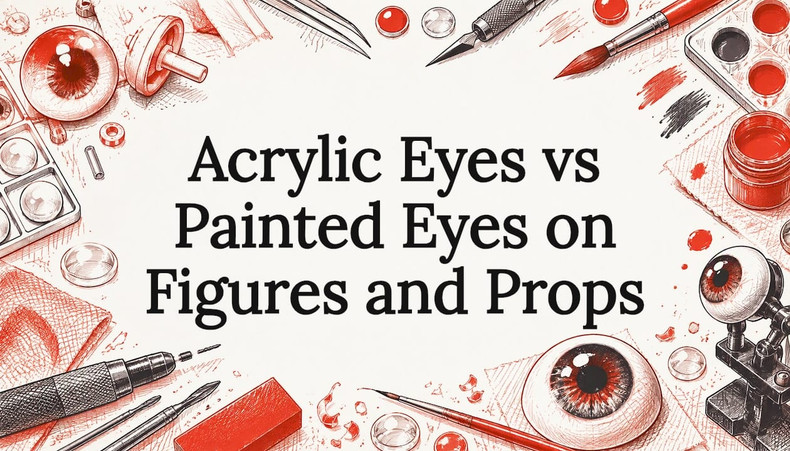
Acrylic Eyes vs Painted Eyes on Figures and Props

Acrylic eyes are inset domes that catch light and can seem to follow you around the room. Painted eyes are built directly on the face, so the artist controls every highlight, shadow and odd little detail. Neither is simply better. Acrylic suits a glossy, lifelike gaze and wide color choice, while painted eyes suit stylized, cartoon and horror characters where the expression is the point. On a life-size piece, the smartest move is to choose the eye style for the character, then have the whole piece planned around it. That is how we approach custom work at 3D Curio Prints, where you can browse life-size 3D printed characters, masks and props.
TL;DR
- Acrylic eyes are domed, so they reflect light and add depth. They come in many colors and styles and are often the most affordable eye option.
- Painted eyes give an artist full control over highlights, pupils and quirks, which makes them a natural fit for cartoon, anime and horror faces.
- The two overlap: acrylic eyes can be hand-finished, and painted eyes can be sealed and varnished to protect the surface.
- Display light is the biggest long-term factor. Keep pieces out of direct sun and use indirect lighting.
- Judge any piece on matching eyes, even depth and angle, a clean fit in the socket and an expression that suits the character.
Table of Contents
- What the two terms actually mean
- Realism and depth: how each one looks
- They are not mutually exclusive
- Durability and care
- Customization and cost
- How to judge a piece before you buy or commission
- What works best for each kind of buyer
- Getting the eyes you want on a custom piece
- Find your next piece
- FAQ
- Sources
What the two terms actually mean
Collectors use these words loosely, so it helps to pin them down.
Acrylic eyes are separate parts that sit in the head. In doll making, a fixed-eyed figure can have inset eyes, generally made of acrylic, or painted eyes. A typical acrylic eye has a dome, a base and a stem. According to a guide to eye sizing and materials, the iris and pupil are painted or glued into an indent in the base, and the clear dome is clipped or glued over it. That layering is where the depth comes from.
Painted eyes are applied straight onto the sculpted surface of the face. There is no separate part. The white of the eye, the iris, the pupil and the highlight are all layers of paint, usually sealed under a clear coat.

On a life-size figure, bust or mask, the same two options apply, just at a bigger scale. A 6-foot figure and a 12-inch collectible have very different viewing distances, and that changes which approach reads better.
Realism and depth: how each one looks
The first thing people notice is depth. A curved acrylic dome catches light and reflects it across the iris. The eye-sizing guide notes that this can give depth and even a “following” appearance as you move around the piece, though the dome height and fit matter, since a tall dome may sit awkwardly in some sockets.
Painted eyes handle depth differently. Instead of relying on a physical dome, the artist builds it with a dark outer ring, a lighter inner iris, a pupil and a highlight placed exactly where the light would fall. Doll-making sources say inset eyes can have depth, while painted eyes can show real artistry, especially when hand-painted.

There is one trap with painted eyes: they can look unnatural when the left and right eye are too similar to each other, according to the same source. Real eyes are never perfect twins. A slight difference in highlight shape or iris shading is what makes a painted face feel alive.
Which style suits which character
- Realistic humans and creatures: acrylic domes give a wet, glassy look that matches a lifelike face.
- Cartoon and anime characters: the eye-sizing guide says acrylic eyes with digitally designed, printed irises are popular for fantasy and anime or cartoon-style looks. Painted eyes work just as well when the character needs flat, graphic shapes, like a classic cartoon with bold pupils.
- Horror characters: painted eyes let an artist add bloodshot veins, dull whites, smeared makeup or a manic stare that a clean factory-made eye would not carry.
- Characters with unusual eyes: star, heart or spiral pupils, multicolored irises and glowing effects are all easier to get with a painted or hand-finished eye.
They are not mutually exclusive
The choice is often framed as either/or, but in practice the two blend. The Stan Winston School, the training arm of the famous creature-effects studio, has a tutorial on making eyes for puppets, masks and makeup effects. It shows how to paint acrylic hemisphere eyes, which means a store-bought acrylic part can be hand-finished into a custom character eye.
That hybrid is worth knowing about if you want a specific look. An acrylic dome gives you the glossy reflection, and hand-painted detail underneath gives you the character. For a collector, the question is not “acrylic or painted?” but “what should this character’s gaze feel like?”
Durability and care
Both styles last for years with sensible display habits. Each has its own quirks, and knowing them is easy.
Acrylic eyes
- Sunlight: inset acrylic eyes can fade or change color in too much sunlight.
- Silver eye: the same source describes a failure where the internal decal separates from the front and the color fades toward silver. It is mostly a concern for older or low-grade eyes.
- Scratches and fogging: plastic or acrylic eyes can pick up scratches or fogging, and vintage plastic eyes can turn cloudy. The Doll Guide advises keeping solvents away from them, so skip harsh cleaners and wipe gently with a soft cloth.
Painted eyes
- Rubs and flaking: painted eyes can show rubs, flaking or overpaint over time, usually where they are handled or touched.
- Protection: a sealed, clear-coated surface helps. If you are curious how clear coats behave on large figures, our guide to clear coat for statues covers how to avoid fogging.
Display light is the big factor
For both styles, where you put the piece matters more than which eye it has. Conservation advice for dolls is to keep natural light off the piece and use indirect artificial light. That applies to a bust on a bookshelf as much as an antique doll.
If you want pieces to look right for decades, a few habits help:
- Place figures away from windows, or use curtains or UV-filtering window film.
- Use warm, indirect lighting rather than a spotlight pointed at the face.
- Dust gently with a soft brush and avoid sprays near the eyes.
- Consider a case for smaller busts and masks. Our comparison of an acrylic case vs a glass case explains how each handles UV and support for 3D prints.
- For masks, see our horror mask display ideas for ways to show and preserve them.
Customization and cost
Acrylic eyes tend to be the most inexpensive option more often than not, because the parts are produced in volume and come in standard sizes and colors. That makes them a sensible choice when you want a convincing look without a big add-on cost.
Painted eyes cost in time instead of parts. The more specific the character, the more careful the painting has to be. A cartoon character with simple eyes is quick. A horror face with layered veining and wet highlights takes patience. Since every eye is painted individually, you also get something no stock part can match: a face that was clearly made for this one character.
Size matters here too. Eyes that are too small can leave gaps, while oversized eyes may not fit or can make the iris or pupil look too large. A painted eye has no such fitting issue, because it is shaped to the face from the start.
How to judge a piece before you buy or commission
Whether you are a collector, a cosplayer or a parent picking out a character for a kid’s room, the same checks apply. Photos of the face from the front and from a three-quarter angle tell you almost everything.
- Do the eyes match? Look for equal size, depth and angle. A collector checklist flags mismatched eyes and unequal depth or angle as warning signs.
- Is the fit clean? For inset eyes, there should be no gaps around the lids and no visible setting material.
- Does the style suit the head? A technically beautiful eye can still look wrong if its style conflicts with the sculpt. Consistency across the face matters.
- Is there a highlight? A small catchlight is what makes an eye look alive. Pure-white eyeballs and perfectly circular, fully visible irises tend to look flat in most expressions.
- Is the finish right? Matte can look more natural on skin, while gloss suits wet-looking eyes. We break down the trade-offs in our guide to matte vs gloss finish for life-size figures.
- How will the light hit it? Eyes behave differently under a lamp, a window or a camera flash. If the piece will be photographed or displayed in a bright room, plan the finish with that in mind.
For glow-in-the-dark or blacklight effects, our guide to UV reactive statue paint shows what is possible on a finished figure.
What works best for each kind of buyer
Collectors who want a display centerpiece usually care about depth and photographic presence. A glossy, domed look suits realistic characters. Painted detail suits stylized ones. Either way, keep the piece in indirect light.
Cosplayers need props that look right at arm’s length and in photos. Eyes on masks and heads need to read from a few feet away, so bold, clearly defined irises and a visible highlight matter more than tiny detail. Our guide to full-head vs face masks covers comfort and detail, and the prevent mask fogging page is useful if you wear one.
Parents choosing a nostalgic character for a kid’s room should lean toward a sealed, durable finish and a friendly, clearly painted expression that matches the cartoon.
Horror fans get the most from painted eyes, because a slightly off gaze is half the effect.
Anime fans often want large, graphic irises, where either printed acrylic or crisp paint can deliver.
Getting the eyes you want on a custom piece
If you want a specific look, the best thing you can do is show it. Clear reference images, covering the front of the face, the eyes up close and the angle you like, save back-and-forth and get you closer to the character you remember. We walk through exactly what to send in our guide on how to provide reference images for a custom prop. For larger commissions, our checklist of 5 checks before you commission life-size UV resin collectibles is a good companion.
Our view on eyes
We build life-size and large figures, busts, masks and props from 80s and 90s cartoons, movies, anime, games and horror, and the eyes are where a piece either comes alive or falls flat. On a heavy, big figure, the face is what people look at first, and it is the first thing a collector notices in photos.
Our view is that the eye style should follow the character, not the other way around. A glossy cartoon character and a gritty horror clown do not want the same gaze. That is why we offer customizable options across our figures and props: so the piece you receive matches the character in your head.
Take your time with reference images, think about where the piece will be displayed, and choose the finish with the light in mind. Do that, and either approach can give you a piece you are proud to show.
Dominick
Find your next piece
If you are ready to bring a character home, our store carries life-size 3D printed characters, masks, cosplay pieces, horror merchandise, lightboxes and signs, wall signs and clocks, nameplates, and wall and desk art. Our collectibles are made heavy, with customizable options for favorite characters across many franchises. Have a look at the full range at 3D Curio Prints, or start with a character like the 14-inch life-size horror clown bust if you want to see how a detailed face looks.
If you have a character in mind that is not listed, send reference images and tell us how you picture the eyes. We would like to hear it.
FAQ
Are acrylic eyes better than painted eyes?
Not across the board. Acrylic eyes offer a glossy dome with depth and many color choices, and they are often the most affordable option. Painted eyes allow total control over expression, which suits cartoon, anime and horror characters. Pick based on the character you want.
Do acrylic eyes fade over time?
They can in strong light. Inset acrylic eyes may fade or change color with too much sunlight, and older ones can develop a silvery look when the internal decal separates. Displaying a piece in indirect light helps protect it.
Can painted eyes be protected from wear?
Yes. A sealed, clear-coated surface helps against rubs, and gentle dusting with a soft brush keeps the finish intact. Painted eyes can show rubs or flaking when they are handled or overpainted, so avoid touching the face.
Can a piece have both acrylic and painted eye details?
Yes. Acrylic eye parts can be hand-painted, as creature-effects training shows with painted acrylic hemisphere eyes. That gives you a glossy dome with custom character detail underneath.
How do I get the eyes I want on a custom figure?
Send clear reference images, including a close-up of the eyes and the angle you like, and describe the mood you want. Our guide to providing reference images for a custom prop explains what to include.
Sources
- Just Magic: Eyes
- Eye Sizing & Material
- How to Make Eyes: Puppets, Masks, & Makeups
- Doll Eye Types Explained: Painted, Glass, Sleep, Flirty
- Everything You Need to Know About Doll Restoration