
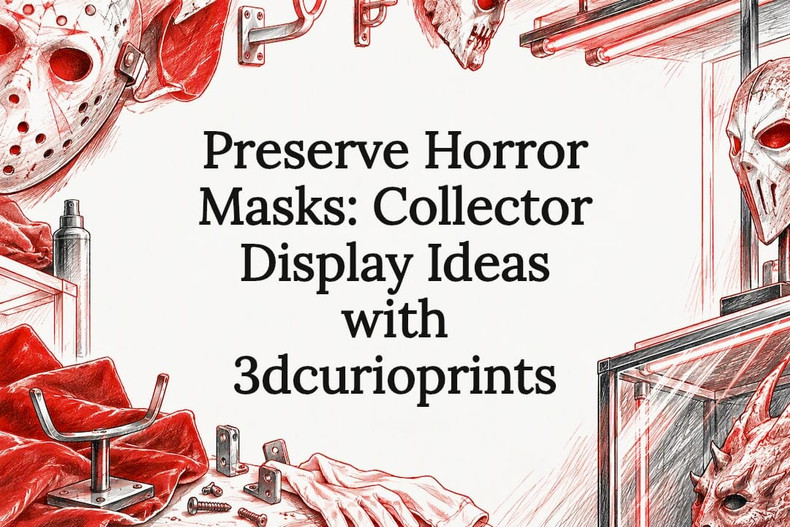
Preserve Horror Masks: Collector Display Ideas with 3dcurioprints

Wall mounting with LED accent lighting gives most horror masks the strongest visual payoff while keeping wear to a minimum. Full-shape latex pieces do better on a form or in a case. The real tension in any collection is impact versus preservation, and every choice below tries to solve both at once. Keep reading for the specific mounts, lighting angles, and spacing rules that make the difference.
TL;DR:
- Mounting masks on drywall with supported hooks or cradle supports prevents damage and requires locating existing hanging points or structural seams.
- LED accent lighting should be placed at 45 degrees behind cases and kept under 4000K to prevent damage and achieve an even, warm glow.
- Layout planning on the floor before drilling helps create balanced groupings with appropriate spacing and focal points, ensuring an intentional display.
- Heavier masks and props need dual anchors, cradle mounts, and, if valuable, logging and insurance to prevent accidents or loss.
- Rigid 3D-printed masks simplify mounting and preservation, making them more reliable display options compared to latex or foam pieces.
Table of Contents
- Horror Mask Display Ideas Worth Trying First
- How to Mount Masks on a Wall Without Damaging Them
- Display Case Lighting Ideas That Don’t Wreck Your Masks
- Planning Layout and Spacing Before You Drill
- DIY and Budget-Friendly Mask Display Ideas
- Choosing Display Cases and Acrylic Boxes
- Styling Ideas for a Cohesive Horror Display
- Securing Heavy Masks and Props Safely
- 3dcurioprints Makes Display Simpler From the Start
- A Note on Preservation and Respectful Curation
- Get Display-Ready Pieces From 3dcurioprints
- Sources
- FAQ
Horror Mask Display Ideas Worth Trying First
Not every mask deserves the same treatment. A rubber slasher mask with a rigid resin shell handles differently than a soft latex creature mask that sags without internal support. Match the method to the piece:
- Wall mounts and hooks for anything with a rigid front and existing hanging loop. Best for focal pieces you want seen from across the room.
- Mannequin heads or shaped forms for full-shape latex masks that need volume to hold their expression.
- Freestanding stands or small shadow boxes for smaller items or pieces you rotate seasonally.
- Acrylic display cases when you want dust protection and a museum-style presentation for higher-value pieces.
- Grouped arrangements work for a themed wall of five or more masks; single-piece treatments suit a hero item that should stand alone.
A curated horror collectibles wall usually looks better with fewer, better-chosen pieces than with every mask you own crammed onto one surface.
How to Mount Masks on a Wall Without Damaging Them
Skip anything that pierces the mask itself. Most masks already have a hanging loop, seam, or interior lip you can hook or cradle. Building your own support is safer than modifying the piece.
- Locate the mask’s existing hanging point or a structural seam that can bear weight.
- Choose a cradle-style mount or padded hook that supports from underneath rather than puncturing.
- For anything over a pound or two, anchor into a wall stud or use a rated toggle anchor instead of a plastic drywall anchor.
- Skip styrofoam heads for long-term use. They can degrade against latex over time and rarely hold detail well.
- Build an internal support instead: line a form with a thin plastic sheet, then pack soft, non-shedding fabric underneath, keeping any solvent-based materials away from the mask’s interior.
- Call a professional framer or conservator for anything culturally significant, extremely fragile, or worth more than you’re comfortable risking on a DIY mount.
Pro Tip: If a mask sags in the cheeks or jaw, a rolled hand towel wrapped in plain cotton fabric tucked inside does more good than any store-bought foam insert.
Display Case Lighting Ideas That Don’t Wreck Your Masks

Light damage builds up over time and never reverses, which is exactly why museum conservation guidance pushes collectors toward LEDs and away from direct sunlight. LEDs run cool and skip the UV and infrared output that older bulb types produce, so they’re the safer long-term choice for anything latex, foam, or fabric-based.
A few placement habits make a real difference:
- Mount LED strips just behind the front frame of a case, angled inward around 45 degrees so the diodes themselves stay hidden and light doesn’t bounce straight back at the viewer.
- Stick to warm color temperatures, generally under 4000K. Anything higher starts to look like a dentist’s office instead of a display.
- Keep the piece out of direct sun entirely. Even filtered window light adds up over months.
- Put lights on a timer or motion sensor so they’re not running when nobody’s looking.
None of this requires expensive gear. A $15 strip of warm white LEDs does the job for most home setups.
Planning Layout and Spacing Before You Drill
Test everything on the floor first. Laying pieces out on a table or the floor before you touch a drill lets you see the actual composition, not just what you imagined in your head.
- Arrange the masks on the floor in your intended pattern and step back to check the balance.
- Center each mask’s eye line near average gallery eye height, roughly 57 to 60 inches from the floor for a standing viewer.
- Leave 2 to 3 inches between smaller masks so the grouping reads as intentional rather than cluttered.
- Vary heights and depths slightly, and give your largest or most striking piece extra negative space around it so it reads as the focal point.
- Transfer the floor layout to the wall with painter’s tape or pencil marks before you commit to any anchor points.
DIY and Budget-Friendly Mask Display Ideas
You don’t need custom cabinetry to make a mask collection look intentional. A wine bottle wrapped in fabric makes a serviceable neck stand for a lightweight mask. A paper towel holder, weighted at the base with sand or coins, does the same job for smaller pieces.
- Line any DIY internal support with a thin plastic sheet before adding soft fabric stuffing. It keeps oils and moisture off the latex.
- Skip solvent-based spray adhesives near the mask interior. The fumes can react with latex and foam over time.
- Add a small patch of black felt behind hollow eye openings. It deepens the shadow and gives the mask a stronger, more finished presence for almost no cost.
- Keep any DIY display away from radiators, sunny windowsills, and anywhere temperatures swing widely.
Pro Tip: That black felt trick behind the eyes is the single cheapest upgrade you can make to a mask that looks flat or lifeless on the wall.
Choosing Display Cases and Acrylic Boxes
A case earns its cost when a piece is either genuinely valuable or unusually light and moisture sensitive. Cases keep dust and stray fingers off the surface while still letting you control exposure.
- Acrylic beats glass on weight and breakage risk, which matters for anything mounted above head height.
- Look for UV-filtering acrylic if the case sits anywhere near a window.
- LED strips and puck lights tucked along the edges or behind the frame stay cool and avoid the harsh glare of a light mounted straight-on.
- Leave a small vent gap for airflow on any case meant to stay sealed for months at a time, especially with latex or foam pieces inside.
Styling Ideas for a Cohesive Horror Display
The masks that photograph well aren’t necessarily the most expensive ones. They’re the ones displayed with a point of view. Group by franchise, era, or even material (all-latex creature masks together, all-resin slasher masks elsewhere) and the wall starts to tell a story instead of looking like a garage sale.
- Add small plaques, movie stills, or index cards noting where a piece came from.
- Rotate a few pieces seasonally, both for variety and to cut down on cumulative light exposure for any single mask.
- Leave breathing room around your best pieces. Crowding kills the effect a standout mask is supposed to have.
Securing Heavy Masks and Props Safely
Heavier resin busts and full-head props need more than a single nail. Use two offset anchor points near the upper edges to stop rotation, paired with a cradle mount that carries the weight from below rather than relying on the hanging point alone.
- Choose stud-mounted hardware or a heavy-duty toggle anchor rated well above the piece’s actual weight.
- Add a discreet secondary tether, inside a case or run along the wall, as backup if the primary mount ever fails.
- Photograph and log any high-value piece, and consider adding it to a homeowner’s insurance policy or a separate collector’s policy.
3dcurioprints Makes Display Simpler From the Start
Latex and foam masks come with real limits: they sag, degrade under light, and often lack a clean way to mount without modification. There are life-size, heavy-duty 3D-printed masks and props designed around display from day one, which sidestep a lot of the organic-material headaches above.
- Printed resin and PLA-based pieces are rigid and maintain their shape over time, unlike latex.
- Rigid material construction can hold detail without internal stuffing or shaped form.
- Certain finish options and mounting-friendly builds can make wall or case placement more straightforward than retrofitting a mount onto a found or vintage mask.
- Heavier construction means the mounting advice above (stud anchors, cradle mounts, dual points) typically applies.
A Note on Preservation and Respectful Curation
Good lighting and clean spacing matter, but so does knowing what you’re displaying. Some masks carry cultural weight beyond their scare factor, and that history deserves a thoughtful placement, not just a dramatic one. If you’re working through a custom display project, reach out. We’re happy to talk through options.
— Dominick
Get Display-Ready Pieces From 3dcurioprints
Most of the mounting and preservation work above exists because latex, foam, and vintage masks were never built with display in mind. Some life-size 3D-printed masks, busts, and props are made heavy-duty and designed to hold their shape indefinitely, with finish options that may make wall or case mounting more predictable than retrofitting a found piece.
Browse the current lineup of masks, cosplay pieces, horror merchandise, wall signs, and desk art built for exactly this kind of display, then reach out through the 3dcurioprints site for details on customization and mounting options for your specific space. If you’re planning a themed room or party wall, pieces from a horror-focused collection or a themed styling case study can round out the mood around your centerpiece.
Sources
Key references: Library of Congress light guidance, Florida mask statute, New York S3070, display case lighting guide.
- Library of Congress — Care of Photographs and Light
- How to set up a horror collectibles wall — WhatIfMonsters
- How to display masks at home — FromTheAndes
FAQ
What is the best way to display Halloween masks?
Wall mounting with soft LED accent lighting works for most masks with a rigid front and existing hanging point. Full-shape latex masks display better on a shaped form or in an acrylic case that supports their volume without pressure points.
Is it illegal to wear a scary mask in public?
It depends on the state. Florida statute 876.13 bars concealing your identity in public, while other states like New York carve out exceptions for costume and theatrical use. Check your local statute before wearing a mask outside a private event or licensed venue.
What are some creative mask display ideas for a themed room?
Group masks by franchise, era, or material rather than mixing everything together, and add small labels or props to give the wall a narrative. Rotating pieces seasonally and leaving negative space around your best item both help the display read as curated instead of cluttered.
How should sellers display masks for sale?
Sellers benefit from the same rules collectors use: even spacing, eye-level placement, and clean, glare-free lighting that shows detail without washing out color. A form or stand that holds the mask’s natural shape also helps buyers see the piece the way it will actually display once purchased.
Are 3dcurioprints masks easier to mount than latex ones?
Yes. Their rigid, heavy-duty construction holds its shape without internal stuffing or a shaped form, and mounting-friendly builds make wall or case placement more predictable. Details on current pieces and customization are available on the 3dcurioprints site.