
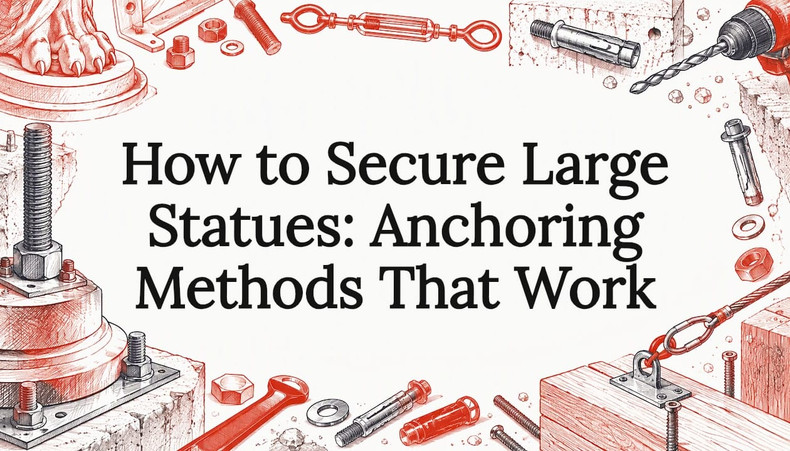
How to Secure Large Statues: Anchoring Methods That Work

To secure a large statue, do three things in order: give it a base at least as wide as the piece, lower its center of gravity with weight low in the assembly, and fasten it to that base and the base to the surface underneath. The right hardware depends on how heavy the statue is, what it stands on, and whether it lives indoors or out. This guide walks through each decision so you can choose with confidence.
TL;DR
- Make the footprint at least as wide as the statue’s widest point, then push gently at the top. If it rocks, the base is wrong, not the statue.
- Put mass low: a heavy base, a weighted plinth or concealed ballast keeps the center of gravity down.
- Pin the statue to its base with threaded rod and epoxy for heavy pieces. Use removable options like museum wax for light ones you may want to move.
- Outdoors, use corrosion-resistant hardware and a proper footing. For tall pieces, high-wind sites or public spaces, bring in a structural engineer.
- Anchor the base to the floor, wall or pad. Fixing the piece to something that can itself slide or fall only moves the problem.
Table of Contents
- Why large statues tip in the first place
- Start with the base, not the glue
- Match the anchoring method to your situation
- Securing a statue indoors
- Securing a statue outdoors
- When to bring in an engineer or qualified installer
- Kids, pets and busy rooms
- Earthquake zones
- A step-by-step process for a heavy indoor statue
- Choose a figure that fits the plan
- FAQ
- Sources
Why large statues tip in the first place
A statue falls when the force pushing it over, whether a bump, a gust of wind or a shaking floor, creates more turning force than its weight and base can resist. Height is the multiplier. A tall, narrow figure standing on a small contact patch has a high center of gravity and very little leverage on its side. Both make it easier to tip.
Three things change that balance:
- Footprint. A wider base gives the statue more leverage against tipping.
- Center of gravity. The lower the mass sits, the more the statue has to be tilted before it falls.
- Restraint. Pins, anchors, wax or tethers stop the statue sliding or lifting off its base.
The J. Paul Getty Museum’s seismic protection work for its collections lists four basic ways to reduce earthquake damage: adding weight low in the display assembly, adjusting the base-to-height ratio for stability, restraining objects by fixing them to the floor, pedestal, shelf or wall, and using base isolation that lets display furniture slide. Those are the same levers a home collector has, just at a smaller scale.
Start with the base, not the glue
Most tipping problems are base problems. Before you buy any hardware, check these basics.
Width and ratio
The base should be at least as wide as the statue at its widest point. This includes outstretched arms, capes, props and anything else that shifts the weight sideways. If a figure leans forward, such as a character mid-pounce, the base needs to extend further in that direction, not just evenly all around.
A simple check: with the statue sitting on its intended base, push very gently at the highest point. It should resist and settle back. If it wobbles or lifts on one edge, widen the base or add weight before you fasten anything.
Weight low in the assembly
A heavy base does more for stability than a clever fastener. If you are building a plinth, a hollow box can be filled or weighted so the mass sits at the bottom. If you are using a ready-made pedestal, check its rated load and how it spreads weight. Pedestal Source, a pedestal maker, notes that standard pedestals typically hold up to 200 pounds and that stability depends on the floor, the pedestal’s footprint and its height. For very heavy pieces on a small contact area, it recommends reinforcing the top by doubling its thickness, adding floor joists underneath and bracing the vertical joints.
The Asian Art Museum’s conservators found something similar when mounting Terracotta Warriors for earthquake country: a broad piece of metal at the base and ankles was needed to handle a calculated moment force of over a ton. They also shaped the mount to fit the figure, which spreads the force and avoids point loading on the surface of the piece. The lesson for a collector: support the statue across a broad area, not at one or two hard points.
Match the anchoring method to your situation
There is no single correct method. Weight, materials and whether you ever want to take the statue off its base decide the answer.
| Situation | Typical approach | Reversible? |
|---|---|---|
| Light to mid-weight statue on a shelf or desk | Museum wax or putty under the contact points | Yes |
| Heavy statue on an indoor pedestal or plinth | Threaded rod pinned into both statue and base with two-part epoxy | No |
| Tall statue in a home with kids or pets | Pinned to a weighted base, base fixed or tethered to a wall stud or the floor | Partly |
| Outdoor statue on a patio or pad | Pinned to a base on a level, drained footing, with stainless hardware | No |
| Very tall, top-heavy or public-facing piece | Engineered footing and anchor plan | No |
Pinning: the default for heavy pieces
Pinning means drilling matching holes in the underside of the statue and the top of the base, then setting threaded rod in epoxy so the two parts lock mechanically. Adhesive alone on a flat joint relies on surface grip, which is the first thing to fail under weight, vibration or a sideways knock. A rod carries that load across the joint instead.

Use stainless steel anywhere moisture is possible. For dry indoor displays, zinc-plated rod is a common choice. Keep the holes slightly larger than the rod so the epoxy fully surrounds it, and dry-fit everything before you mix.
Wax and putty: for pieces you want to move
For lighter figures in stable indoor spots, museum-grade wax is a sensible option because you can lift the statue off later without damage. It holds against small bumps and vibration, not against a determined shove. Treat it as the finishing touch on a stable base, never as the main restraint on a tall heavy piece.
Securing a statue indoors
Indoors, the surface under the base matters as much as the fastener.
Floors. A statue standing directly on a hard floor is only as secure as its footprint. If you fix the base to the floor, use anchors suited to the floor material, such as masonry anchors for concrete and structural screws into joists for wood framing. Do not rely on a screw into subfloor sheathing alone for a heavy base.
Pedestals and plinths. The pedestal itself becomes part of the statue. Make sure it is level, sits on a floor that does not flex, and is wider than the figure at the top. If the pedestal is lighter than the statue, it is the weak link. Weight it or fix it to the floor.
Walls. For tall, slim pieces, a discreet tether from the base or the figure to a wall stud adds a second line of defense. Fix to the stud, not to drywall alone. Drywall anchors are rated for far less than a heavy statue can put on them.
Shelves. A shelf is a pedestal with a weight limit. Check the bracket rating and stud positions before loading a large piece. If you are planning a display wall, our guide to displaying large statues safely at home covers placement, spacing and load in more detail, and the statue scale guide helps match a figure to the space you actually have.

Securing a statue outdoors
Outdoor installations face temperature swings, moisture, UV and wind, and each one attacks the joint between statue and base. Plan for that from the start.
- Build a level footing. The base should sit on compacted, well-drained ground or a concrete pad, clear of standing water. A footing that settles unevenly will tilt the statue over time, whatever the fastener.
- Size the footing to the piece. Heavier and taller pieces need a deeper, wider footing. If you are unsure, treat the footing as a small construction job rather than a garden chore.
- Use exterior-rated hardware. Stainless steel rod, waterproof epoxy or grout, and corrosion-resistant fasteners. A zinc-plated bolt that is fine on an indoor shelf will rust and stain outside.
- Pin the statue to the base, and the base to the footing. Two connections, each doing its own job.
- Let it cure. Concrete and structural epoxy need their full cure time before you load the piece or lean on it. Follow the product’s instructions rather than rushing a weekend project.
- Plan for wind. A statue with a large flat face acts like a sail. If it is tall or the site is exposed, add mass and restraint accordingly.
Check how the piece itself is built before you drill into it. Always tell yourself exactly where you will drill and how deep, and mark it before you start. Never improvise structural work on a piece you cannot replace.
When to bring in an engineer or qualified installer
Some jobs go beyond DIY. Call a structural engineer or an experienced installer when:
- the statue is tall, slender or top-heavy enough that wind loads matter;
- you are fastening to a roof, an upper-floor slab or any suspended structure;
- the site is in a high-wind area;
- the piece will stand where the public can reach it.
Burning Man’s art installation guidelines give a useful benchmark from a place where wind is a constant. For structures taller than 10 feet, or where a failure could threaten safety, structural stability must be assured, and a structural engineer should create the anchor plan. Their guidelines also describe steel anchors rated at 3,000 pounds each in vertical tension, placed at least 3 feet apart. That is a festival standard, not a home code, but it shows how seriously large freestanding pieces are treated.
The same logic applies to mounting any heavy, awkward object at home. A walkthrough on installing a large mirror safely shows how to think about load, fixings and when to hand the job to a professional. For heavy objects that are hard to lift, an experienced crew also matters: furniture anchoring practices from a moving crew show how professionals secure big items against tipping.
If you only need help moving a heavy piece into place, hire people who do it for a living. Heavy items injure people before they ever tip over.
Kids, pets and busy rooms
A statue that is stable on a quiet shelf can be a hazard in a hallway or playroom. Ask these questions about each piece.
- Can a child reach or climb it? Assume yes. Fasten the base to the floor or wall, and keep heavy statues low and out of walkways.
- Can a pet knock it? Wagging tails and running dogs hit the lower third of a statue. A wide, weighted base and a wall tether handle that.
- Does the floor vibrate? Doors slamming, stairs, subwoofers and washers all send shocks through floors. Wax or pinning stops small shifts from becoming a walk toward the edge.
- Is the piece in a high-traffic spot? Keep it out of the path, or give it a corner where it has two walls beside it.
For displays where a fall is more likely, the extra step is cheap: museum wax under the base plus a discreet tether to a pedestal or wall.
Earthquake zones
If you live where earthquakes are common, restrain every heavy display piece. The Getty team’s conclusion is that anchoring the casework to the floor or wall is always the best choice, because the object, the casework and the building then move together. They also say that a design that is insufficient can be useless and even make things worse, and that a safety factor of three is generally considered good practice when choosing the strength of mount materials. In plain terms: size fasteners well above the weight they carry, and anchor to something solid.
The Asian Art Museum adds that even a building with base isolators still needs individual mounts for each artwork, because quakes still produce significant accelerations. A building’s protection does not replace yours.
A step-by-step process for a heavy indoor statue
- Weigh the statue and measure its widest point and height.
- Pick a location away from foot traffic, on a firm level floor.
- Choose a base at least as wide as the statue, heavy enough to keep the center of gravity low.
- Dry-fit the statue on the base and do the gentle push test.
- Mark the pin positions on the underside of the statue and top of the base. Keep them away from edges and fragile details.
- Drill matching holes, test the rod depth, then clean out dust.
- Mix two-part epoxy, fill the holes, set the rod and seat the statue. Wipe squeeze-out and let it cure fully.
- Fix the base to the floor or tether it to a wall stud if there are children, pets or a shaky floor.
- Recheck the setup after a week and again each season.
Storing or moving the statue later is a separate problem. Our guide to protecting heavy collectibles in storage covers that, and if a piece arrives damaged, here is what to do next.
Our view on securing big statues
We build life-size and large 3D-printed figures, masks and props, and we make them heavy on purpose. A figure with real weight sits better, feels better and reads as a collectible instead of a toy. That same weight is a gift for stability: mass low in a piece is exactly what keeps it from tipping.
Our advice is to plan the display before the figure arrives. Decide where it stands, how wide the base needs to be and what it will be fastened to. Our characters come in many sizes and franchises, from busts to full-height figures, so the plan changes with the piece. A desk-sized bust needs a firm surface. A figure over six feet needs a floor and a footprint to match.
We like the pinned-base approach for the largest figures because it treats the statue like the serious object it is. We also like a wide, weighted base for anyone who wants the freedom to rearrange a collection. Either way, you are protecting something you chose because you love it, and a few hours of setup keep it standing for years.
Dominick
Choose a figure that fits the plan
If you are still choosing a piece, think about your wall, shelf and floor space first. We make heavy, detailed, customizable figures across cartoons, movies, anime and horror, from tabletop busts to life-size characters. Browse the full range on 3D Curio Prints, or look at a statement piece like the life size 6ft 4in superhero model if you are planning a dedicated display corner.
For mid-size options, a 26 inch Bart Simpson statue or a 14 inch horror clown bust suits a shelf or plinth. If you want a themed room, our arcade room statue guide helps with placement.
FAQ
How do I keep a large statue from falling over?
Widen the base so it is at least as wide as the statue’s widest point, and put weight low in the assembly. Then fix the statue to the base with pins or epoxy, and fix the base to the floor, wall or footing. Test with a gentle push at the top before you let go of it.
Can I anchor a statue without drilling?
For lighter indoor pieces, museum wax or putty under the contact points holds against bumps and can be removed later. A wide, weighted base also helps without any drilling. For heavy or tall statues, a pinned connection is more secure, so plan for drilling in the base at least.
What hardware should I use outdoors?
Use stainless steel rod and corrosion-resistant fasteners, with exterior-rated epoxy or grout. Outdoor joints see moisture, UV and temperature swings, which break down ordinary hardware. Set the statue on a level, well-drained footing.
When do I need a structural engineer?
Call one for tall or slender pieces, high-wind sites, roofs and upper-floor slabs, and statues in public areas. Burning Man’s guidelines, for example, call for an engineered anchor plan for structures above 10 feet. If you are unsure, ask for an assessment before drilling.
How heavy a statue can a pedestal hold?
Standard pedestals typically hold up to 200 pounds according to Pedestal Source, though stability also depends on the floor, footprint and height. For heavier pieces, reinforce the top and add support underneath. Always check the rating on the specific pedestal you buy.
Sources
- Protecting Collections in the J. Paul Getty Museum from Earthquake Damage
- Seismic Protection for Art and Antiquities: Preparation of Display Mounts, Asian Art Museum
- Frequently Asked Questions, Pedestal Source
- Building Safe Structures, Burning Man Project
- How to install a large mirror safely
- Furniture anchoring safety