
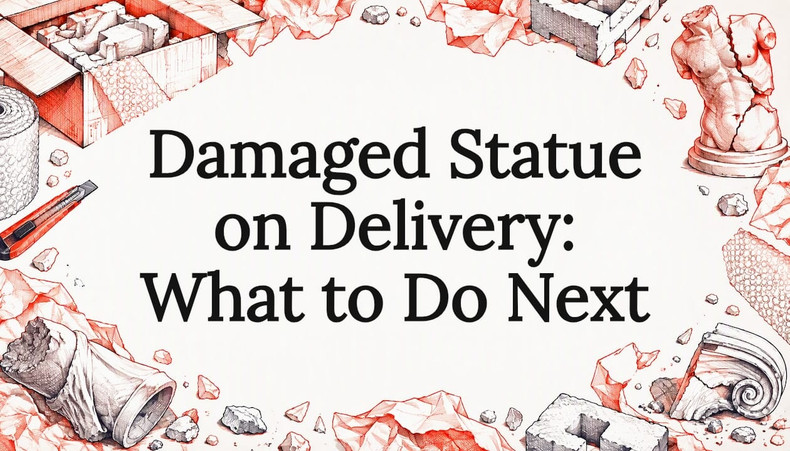
Damaged Statue on Delivery: What to Do Next

If your statue arrived cracked, chipped or in pieces, do four things before anything else: stop unpacking, photograph the box and the damage, keep every piece of packaging, and contact the seller right away. Most claims are won or lost on the evidence you gather in the first hour, and the clock on carrier claims starts at the mailing date, not the day you open the box.
This guide walks through the whole process for a US buyer: what to do at the door, how to document the damage, who is responsible, how to file a claim, and what to ask the seller for.
TL;DR
- Note visible box damage with the driver before you sign, then photograph the package, the packing and the statue as you unpack.
- Keep the box, foam, wrapping and labels. Do not throw anything away or reship it, because the carrier may want to inspect it.
- Contact the seller first. Your purchase contract is with them, and most sellers are expected to make it right, then sort out the carrier themselves.
- For USPS insured parcels, a damage claim must be filed no later than 60 days after the mailing date.
- Ask for what you want in plain terms: repair, replacement or refund.
Table of Contents
- At the door: before you sign
- Unboxing: document everything
- Who is responsible for shipping damage
- Contact the seller the right way
- Filing a carrier claim and the deadlines
- What to keep until the claim closes
- Repair, replace or refund: choosing
- Shopping for a statue built to last
- Preventing damage next time
- FAQ
- Sources
At the door: before you sign
Heavy statues travel in large boxes or crates, and the outside tells you a lot. A crushed corner, a punctured side, a box that has been re-taped or a crate with splintered slats are all signs the contents took a hit.
SculptureSite Gallery’s FAQ gives a sensible sequence for exterior damage: tell the delivery driver before you sign, notify the seller immediately, unpack carefully and photograph the statue as you go. We would add a few habits that cost nothing:
- Take a photo of the box on your porch before you move it, with the shipping label visible.
- If the driver is still there, ask them to note the damage on the delivery record, or take a photo of the driver with the box.
- If you sign on a handheld device, write “visible damage” in any note field if one is offered.
- If the box looks fine but you feel loose pieces rattling, treat it the same way. Hidden damage is common with heavy resin and 3D-printed pieces.
Do not refuse to open the box out of caution. You need to see the item to know the extent of the damage, and you can still file a claim afterward.
Unboxing: document everything
Set up a clear surface with good light, ideally a floor or table you can walk around. Then work slowly.
- Film the opening. A continuous video of you cutting the tape and lifting the item out shows the condition of the packing as it arrived.
- Photograph the packing layers. Foam, bubble wrap, void fill, corner guards. If the statue shifted because the box was too large or the padding was thin, that matters.
- Photograph the damage from several angles. Take one wide shot of the whole piece, then close-ups of each crack, chip or detached part, with a coin or ruler for scale.
- Collect the broken pieces. Bag them and label them. Do not discard small fragments.
- Photograph the label and the paperwork. The tracking number, the shipping label and the packing slip tie the damage to your order.
Retailer help pages say the same thing. Artifact Uprising, for instance, asks customers to send clear photos of the product and packaging, including any visible box damage.
Do not glue anything yet
It is tempting to fix a snapped finger or a detached ear on the spot. Hold off. USPS guidance says to keep the original packaging, the damaged item, wrappings, labels and contents until the claim is resolved, and not to throw them away or reship them, because inspection may be required. A repaired item is harder to prove was ever broken. Wait until the seller or carrier has told you how the claim will be handled.
Who is responsible for shipping damage
The short answer for most online purchases: the seller is your first point of contact. A logistics company’s guide on damaged products says that in most cases the seller is initially responsible for making it right, unless a different arrangement was agreed before purchase, even when the carrier caused the damage. The seller may not be at fault, but good sellers resolve the problem to keep the customer’s trust, and then pursue the carrier.
A note on law: consumer group Which? explains that under the UK Consumer Rights Act, the retailer is responsible for goods until they are delivered to you, and you should not accept being sent to the courier. That is a UK rule. US rules differ by state and by the terms of sale, so read the seller’s shipping and returns policy and the terms at checkout. Our guide to statue warranty terms covers what to look for before you buy.
Where the carrier fits in
Liability in transit can sit with the shipper, the carrier or the recipient depending on the carrier type and the sale terms. Harvard’s risk management office notes that common and contract carriers are generally responsible, but the bill of lading may limit liability. The same page says FedEx and USPS limit liability to $100 per parcel unless a higher value is declared and an extra fee paid.

That $100 default is why declared value and insurance matter so much on a statue worth several hundred dollars. If the seller insured the parcel, the claim can cover the real value. If nobody did, the payout may be tiny, and the seller’s goodwill becomes your main route to a fix. Our article on statue shipping insurance explains what coverage includes and how claims run.
If your statue shipped as freight on a pallet or crate rather than as a parcel, a broker is not who you file with. The FMCSA states that a freight broker assumes no responsibility for the shipment and claims go to the motor carrier, though brokers may help with the process.
Contact the seller the right way
Send one clear message the same day. Make it easy to say yes:
- Your order number and the delivery date.
- A one-sentence description: “The left arm snapped at the shoulder and the base has a crack.”
- Six to ten photos and the unboxing video link.
- What you want: a repair kit or professional repair, a replacement, or a refund.
- A request for the next steps, including whether they want the item and packaging returned.
SculptureSite Gallery says it will work with buyers to repair, replace or refund a damaged purchase, at the buyer’s preference. That is a good model of what a reasonable seller offers. State your preference clearly, but stay open: for a made-to-order piece, a replacement may take weeks because it has to be printed and finished again.
Keep the tone factual
No need for heat. A message with dates, photos and a specific request gets a faster answer than a long complaint. If you get no reply within a couple of business days, follow up and mention the claim deadlines below. If the seller does not respond at all, a credit card dispute is a separate route; check your card issuer’s rules for the time limit.
Filing a carrier claim and the deadlines
Often the seller files the carrier claim, but you may be asked to help or to file yourself. For USPS insured parcels, the agency says either the sender or the recipient may file, and a damage claim may be filed immediately but no later than 60 days after the mailing date. Publication 122 repeats that eligible domestic claims are filed online with the tracking number and required documents, including proof of value and damage.
What USPS wants to see:
| Item | Why it matters |
|---|---|
| Tracking or label number | Links the claim to the parcel |
| Evidence of insurance | Shows the parcel was covered |
| Proof of value | A sales receipt or paid invoice |
| Clear photos of the damage | Show the extent of the loss |
| Repair estimate, if requested | USPS says a reputable dealer’s estimate may be required |
The agency also warns that failing to present the item and all packaging for inspection on written request will result in denial. That is the reason to keep everything exactly as it arrived.
Other carriers and freight lines set their own windows. If your statue came by freight, this overview of freight insurance claims explains how evidence is typically assembled, and this shipper’s guide to filing freight claims on time shows why timing matters. For any carrier, check its current claim page for deadlines, because they can change.
What to keep until the claim closes
Create one folder on your phone or computer and one physical box for the item. Put these in it:
- Order confirmation and receipt
- Shipping confirmation email and tracking number
- All photos and the unboxing video
- The outer box, inner packing and shipping label, untouched
- The broken statue and every fragment
- Every message with the seller and carrier, with dates
If you also hold a collectibles policy, tell your insurer. Our collectibles insurance guide lists what to document so a claim is not rejected for missing paperwork.
Repair, replace or refund: choosing
Deciding what to ask for depends on the damage and on how much you want this exact piece.
Ask for a replacement when the break is structural (a split torso, a cracked base, a snapped support) or when the finish is damaged across a large area. Painted and glued joins on heavy pieces rarely look the same after a home repair.
Ask for a repair when the damage is a clean break of a small part and the seller or a professional can fix it. Let the seller tell you whether they want to send replacement parts or want the piece returned.

Ask for a refund when you no longer want the item, the model is discontinued, or the timeline for a replacement does not suit you, for example if the statue was a gift for an event.
Whatever you choose, get the resolution in writing before you ship anything back, and ask who pays for return freight on a heavy item.
Our view: heavy pieces deserve heavy packing
We make life-size and large 3D-printed figures, masks and props, and weight is part of the appeal. A piece with real heft feels like a collectible when it is on your shelf. It is also the piece that punishes thin packaging the hardest in a truck.
That is why we think about a statue’s journey as part of its quality, alongside print detail and finish. A figure built to be sturdy and displayed for years should arrive protected by packing designed for its weight, and we encourage every buyer to inspect on arrival and document right away.
If something is wrong with your order, we want to hear about it with photos, so we can look at the problem together. Our collectors’ inspection list in the workshop checklist for premium statues shows the six points we check on every piece.
Dominick
Shopping for a statue built to last
If you are replacing a damaged piece or starting a collection, our store carries life-size and large 3D-printed characters, horror busts, anime figures, masks and wall art. Examples include the 26-inch Bart Simpson statue at $269.99, the 14-inch life-size horror clown bust at $299.99 and the 15-inch life-size Stitch at $189.99. Browse everything on the 3D Curio Prints store.
We offer customizable options on many characters, so tell us what you are after and we will point you to the right piece.
Preventing damage next time
You cannot control the truck, but you can improve the odds.
- Check the shipping terms before checkout. Look for whether insurance or declared value is included, and how the seller packs heavy items. Our piece on life-size figures versus statues explains why large orders mean weeks of lead time and heavy crates.
- Ask about packing. Double-boxing, rigid corner protection and a snug fit with no empty space are the basics for fragile decorative items. For more on what good gift and product packaging looks like, see these gift box design trends.
- Choose delivery you can supervise. If you can be home, you can inspect and note damage with the driver.
- Plan where it will live. Measure the spot and the doorway first. Our scale guide and guide to displaying large statues safely help.
- Store the packaging. If you must keep a piece in storage, our statue storage tips cover protecting heavy collectibles. Keeping the original box also helps if you ever need to return or reship.
FAQ
Who pays if my statue is damaged in shipping?
Usually the seller deals with you first, then recovers the cost from the carrier or its insurance, unless the terms of sale say otherwise. If nobody declared extra value, carrier liability can default to a low cap such as $100 per parcel on FedEx and USPS. Read the seller’s shipping terms and ask who filed or will file the claim.
How long do I have to report a damaged delivery?
Tell the seller the same day if you can. For USPS insured parcels, a damage claim must be filed no later than 60 days after the mailing date. Other carriers and sellers set their own windows, so check the policy for each and do not wait.
Can I fix the statue myself with glue?
Wait until the claim is settled. Carriers may ask to inspect the item and all packaging, and a denied claim is a real risk if you have altered or discarded them. Once the seller or carrier confirms the resolution, a repair is your call.
Should I contact the courier or the seller?
Start with the seller, because you bought from them. Tell the driver about visible damage at the door, then let the seller guide the carrier claim, or file it yourself if the carrier allows recipients to file, as USPS does.
What if the box looks fine but the statue is broken inside?
Report it anyway, quickly, with photos of the intact box, the packing and the break. Concealed damage claims are common with heavy items, and keeping all packaging untouched helps the carrier’s inspection.
Sources
- SculptureSite Gallery FAQs
- Who’s Responsible For Damaged Products & What To Do Next
- How to complain if you receive damaged goods in the post (Which?)
- Goods & Equipment in Transit (Harvard Risk Management)
- Does a broker process loss and damage claims? (FMCSA)
- My Order Arrived Damaged or Incorrect (Artifact Uprising)
- Publication 122: Domestic Claims Customer Reference Guide (USPS)
- File a Claim (USPS)