
How Makers Reach 60–72 MPa: Resin Print Strength, Cure, and Design
Engineered, tough, and composite resins can beat common thermoplastics on tensile and flexural strength once they’re fully post-cured, but that’s only half the story. Standard resins stay brittle by design, and both chemistries lose ground fast to UV exposure and sharp impacts without added protection. Whether resin is “strong” depends entirely on which failure mode you’re worried about: bending load, a sudden drop, or five years on a sunny shelf.
TL;DR:
- Perfectly post-cured tough or composite resins can reach tensile strengths of 55 to over 90 MPa, but standard resins remain brittle and vulnerable to UV damage.
- Resin parts are more isotropic than FDM plastics, but impact resistance and elongation are generally superior in filament materials like PETG and ABS.
- Proper curing, especially UV post-treatment, significantly increases resin strength, with under- or over-curing leading to soft, brittle, or prematurely cracked parts.
- Design choices such as adding fillets, ribs, and orienting parts along the strongest axis more strongly influence real-world durability than resin selection alone.
- Large, load-bearing or outdoor parts require segmentation, strategic reinforcement, staged curing, and protective coatings to ensure longevity over years.
Table of Contents
- How strong is resin print strength across the major property tests
- Resin vs FDM plastics: where each one actually wins
- What actually changes resin print strength in practice
- How to design and print for maximum real-world strength
- Building large display pieces that hold up over years
- Why the strength conversation misses the point
- Sources
- FAQ
How strong is resin print strength across the major property tests
Resin doesn’t behave like one material. The strength numbers swing wildly depending on chemistry and how well the part was cured, which is why lumping “resin” into a single strength rating misleads more than it helps.
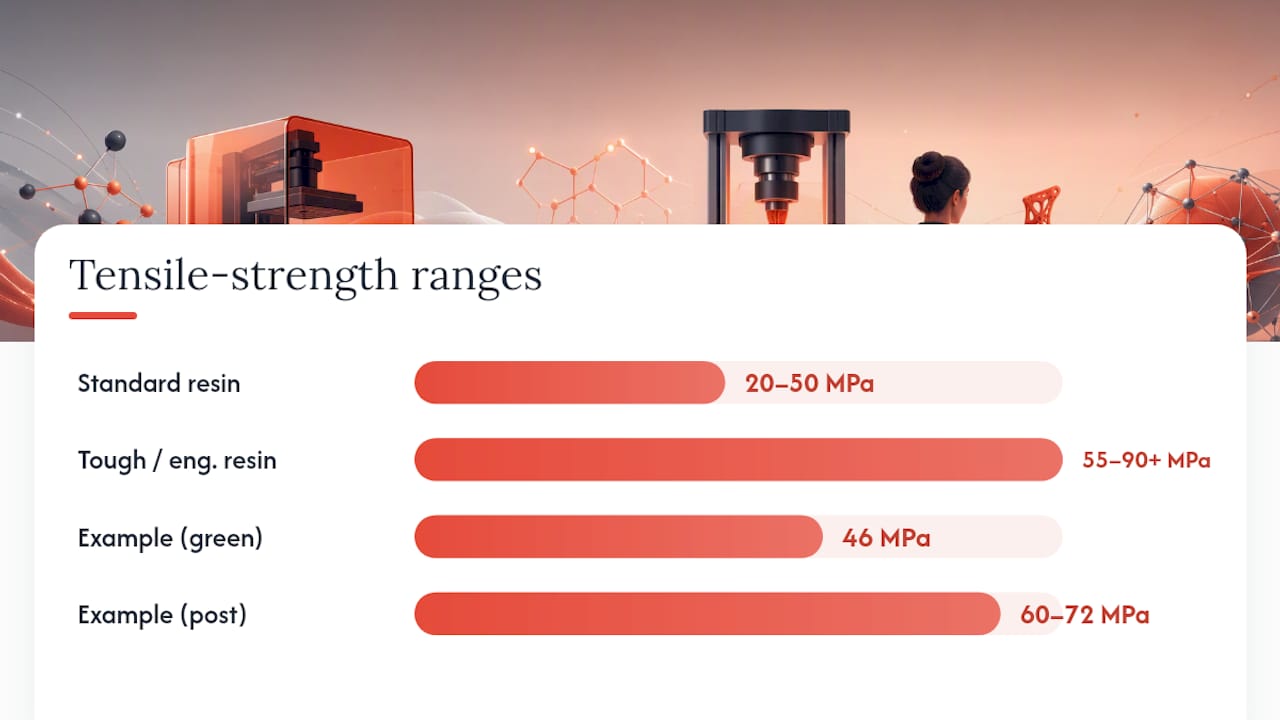
Standard resins, once fully post-cured, typically land around 20 to 50 MPa in tensile strength. Tough and engineering-grade resins push that to roughly 55 to 90+ MPa, and composite-filled or ceramic-loaded systems can reach very high flexural and compression strengths through specialized formulations. That’s a wide enough spread that picking the wrong resin family for a load-bearing part is a common, expensive mistake.
Four ASTM standards govern how these numbers get measured: D638 for tensile strength, D790 for flexural strength, D695 for compression, and D256 for impact resistance (Izod). Each tells you something different, and none of them tell you the whole story alone.
Elongation at break and impact strength (measured in J/m under ASTM D256) tell you whether a part will flex or shatter. Tough resins can push elongation past 20%, buying real margin against sudden shock loads.
Resin vs FDM plastics: where each one actually wins
A controlled comparison found general-purpose SLA resin hitting about 68.9 MPa ultimate tensile strength, compared to PLA and ABS landing near 47 to 50 MPa under the same test conditions. On pure tensile numbers, resin often wins outright. But tensile strength isn’t the only thing that matters when a part gets dropped, twisted, or left in a truck bed all summer.
- Tensile and stiffness: engineered and rigid resins frequently beat PLA and ABS, especially in thin, precise geometries where FDM layer lines create weak points.
- Impact resistance and elongation: FDM filaments, particularly PETG and some ABS blends, tend to absorb sudden shock better than standard resin, which fails abruptly at stress risers instead of deforming first.
- Anisotropy: FDM parts are weaker between layers than along them; resin parts are more isotropic overall but can develop their own weak planes if supports or exposure settings are inconsistent.
- Practical picks: choose tough resin or a ductile filament for snap-fits, hinges, or anything that gets bumped; choose rigid or composite resin for jigs, fixtures, and small parts needing dimensional accuracy under load.
If a part will take a hard hit, resin’s brittleness is the bigger risk. If it just needs to hold a precise shape under steady load, resin usually has the edge.
What actually changes resin print strength in practice
Chemistry sets the ceiling, but processing and environment decide whether you ever get close to it. Standard resins are cheap and detailed but brittle. Tough resins trade some stiffness for elongation. Engineering and rigid-filled resins add glass or ceramic particles for stiffness and heat resistance. Composite resins push mechanical numbers highest but can be harder to print cleanly. Elastomeric resins sacrifice strength entirely for flexibility, and comparing them to rigid families on tensile numbers is pointless.
Post-curing is where most of the real gains happen. One documented example showed tensile strength rising from about 46 MPa green to 60 to 72 MPa after proper UV post-cure, tested under ASTM D638. Flexural strength climbs similarly. Skip post-cure, or rush it, and you’re printing with a fraction of the resin’s real capability.
Pro Tip: Cure schedule is a mechanical dial, not a cosmetic finishing step. Under-curing leaves parts soft and prone to creep; over-curing on some chemistries increases brittleness instead of strength.
Three factors decide whether your printed strength matches the datasheet:
- Cure time and intensity. A 60-minute post-cure produced peak tensile results in one test setup; longer exposure shifted the same resin toward brittleness rather than helping it.
- Specimen orientation during testing. Vendors don’t always test in the orientation you’ll print, so datasheet numbers can overstate real part performance.
- Environmental exposure. Standard resins are not inherently UV-stable and can yellow, embrittle, or crack within months of direct sunlight. UV-resistant resins and clear protective coatings extend that life considerably.
How to design and print for maximum real-world strength
Material choice matters less than most people assume. Design geometry, cure discipline, and orientation choices routinely swing real-world durability more than swapping to a marginally stronger resin.
- Add fillets at internal corners; sharp 90-degree angles concentrate stress and are where resin parts crack first.
- Thicken walls locally at load points and mounting holes instead of uniformly bulking the whole part.
- Add ribs or gussets along load paths rather than relying on shell thickness alone.
- Orient the part so the primary load runs along the strongest print axis, not across layer lines.
- Place supports away from cosmetic or load-bearing surfaces to avoid notch-like scars that act as crack starters.
- Follow the resin manufacturer’s cure schedule exactly. Thick or composite-filled sections may need staged or thermal post-cure to finish crosslinking without over-baking the surface.
- Apply a UV-resistant coating on anything headed for a window, patio, or outdoor display.
For parts facing impact risk, pick a tough resin family. For stiffness and dimensional accuracy under sustained load, go rigid or composite. Reaching for a stronger resin before fixing an obvious stress concentrator is usually wasted effort.
Building large display pieces that hold up over years
Life-size figures and heavy props change the calculus. A six-foot piece carries weight and leverage that a desktop miniature never has to survive, so Internal segmentation, wall thickness, and mechanical reinforcement are treated as first-order decisions rather than afterthoughts. Splitting a large figure into structural sections lets each piece cure evenly and lets thicker walls go exactly where load concentrates, like ankles, necks, and mounting points.
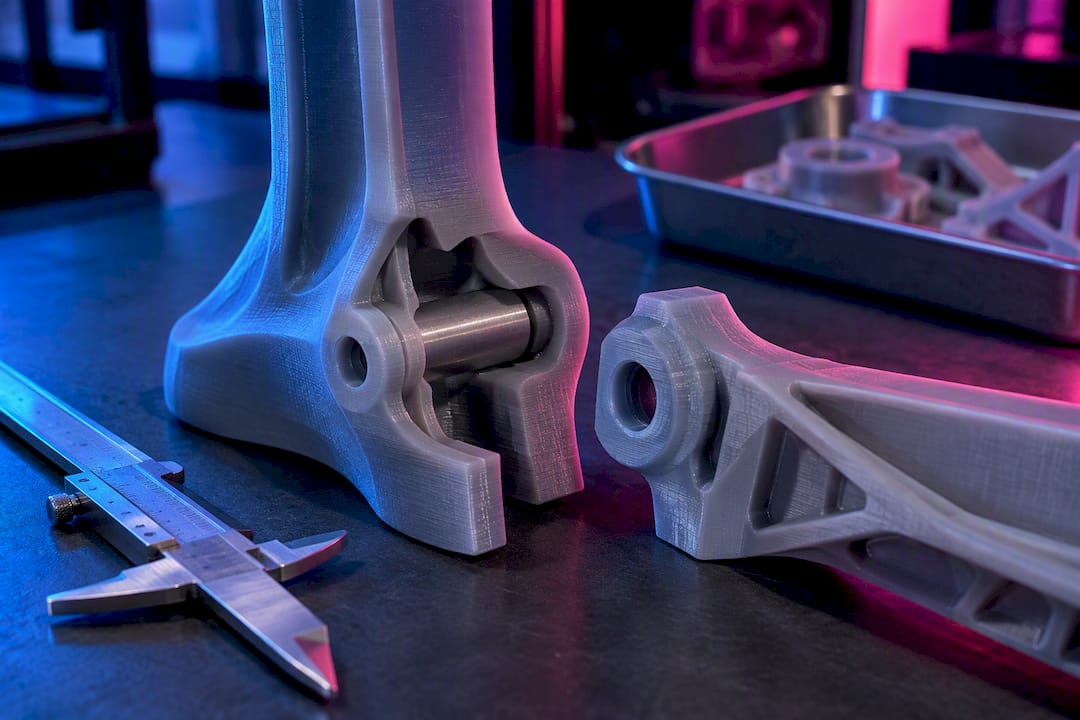
Staged cure schedules and protective coatings are standard practice for anything meant to stand in a living room or patio for years, not weeks. Surface finish and mechanical robustness pull in different directions sometimes: a thinner shell photographs beautifully but concentrates stress, while reinforced sections add weight and cost. Getting that balance right, piece by piece, is what separates a display prop that lasts from one that cracks at the ankle after a year.
Why the strength conversation misses the point
Most guides treat resin strength like a single number you can look up and compare, then move on. That framing falls apart the moment you’re building something bigger than a keychain. The tensile number on a datasheet assumes a fully cured, correctly oriented, thin test specimen. Nothing about a heavy prop or life-size figure matches those conditions.
The research here supports a different priority order: fix geometry first, validate cure schedule second, and treat resin family selection as the third lever, not the first. A tough resin poorly cured with sharp internal corners will fail before a standard resin with fillets and a proper UV cure. That’s not the story resin marketing tells, because “our resin hits 90 MPa” sells better than “your design has three stress risers.”
If you take one thing from this, let it be that cure schedule is not a suggestion.
— Dominick
Sources
- How Strong Is Resin? (Raise3D)
- Resin (SLA) vs Filament (FDM): Strength Comparison (FilamentSpecs)
- SLA 3D Printing Material Properties — PartSnap
- How long do resin 3D prints last? (Additive Plus)
FAQ
Is resin printing stronger than PLA?
Engineered and tough resins often beat PLA on raw tensile strength, with one comparison showing SLA resin near 68.9 MPa versus PLA around 47 to 50 MPa under the same test. PLA still tends to handle sudden impacts better since standard resin fails more abruptly at stress points.
Is resin as strong as ABS?
On tensile strength, yes, and often stronger. That same comparison put ABS in the same 47 to 50 MPa range as PLA, well below cured SLA resin’s roughly 68.9 MPa, though ABS generally holds up better under impact and repeated flexing.
How hard is resin to break?
It depends entirely on the resin family and cure state. Standard resins are brittle and can snap under a sharp impact or drop, while tough and engineered resins post-cured to the 60 to 72 MPa range resist cracking far better, though they still fail more abruptly than ductile plastics.
Is resin as strong as concrete?
No. Concrete’s compressive strength typically runs into the thousands of PSI, far beyond even composite-filled resin’s roughly 158 MPa compression rating. Resin competes with concrete on precision and detail, not on raw structural load bearing.