Event Planners: 4 Life Size 3D Printed Photo Booth Props to Commission

The best life-size 3D-printed photo booth props fall into four categories: freestanding character figures, modular backdrop panels, wearable masks or busts, and themed vignette pieces. For events, commission or buy a finished, professionally painted piece rather than a raw print. If the design involves a recognizable character, confirm licensing before you order.
TL;DR:
- Matte surfaces reduce flash hot spots, while gloss can reflect phone flashes; use rear rim lighting and side fill to preserve detail.
- Painted, illuminated life size pieces take 6 to 12 weeks or longer; confirm the deposit to delivery schedule, since rushed work can skip finishing steps.
- For multi part designs, ask about armatures, base load limits, registration features, and documented test fits, since cooling can distort sections after removal.
- Enclosures vented outdoors or local exhaust reduce escaping ultrafine particles by 97% to 99%; ordinary room airflow may not protect sustained indoor printing.
- Before guests arrive, assemble the full prop, take camera test shots, check section alignment and mounting hardware, and adjust lights to catch problems.
Table of Contents
- High-impact life-size 3D-printed photo booth prop ideas
- How to choose a life-size 3D-printed prop: criteria that actually matter
- Production and technical realities: printing, metrology, warping, and finishing
- Safety and legal checklist for orders and displays
- Transport, installation, and on-site setup: practical event tips
- Commissioning finished figures versus building your own
- 3D Curio Prints: commissioning life-size figures and event-ready props
- FAQ
- Sources
High-impact life-size 3D-printed photo booth prop ideas
A finished prop needs to do two jobs: hold up physically and photograph well under event lighting. Some shapes do both far better than others.
- Character figures: freestanding, posed statues work as hero shots and anchor a themed backdrop without needing extra set dressing.
- Modular backdrop panels: assembled scenes ship in parts and scale up or down to fit a venue, which matters when you do not know the room until load-in day.
- Wearable masks and busts: give guests an interactive photo op instead of a static display, useful for cosplay meetups and horror-themed parties.
- Themed vignette props: an oversized chair, a neon horror sign, or a sport nameplate paired with a figure, builds a scene instead of a single object.
Lighting changes how any of these reads in a photo. A single front-facing flash flattens detail on a large figure, so add a rim light behind the piece to separate it from the backdrop and a soft fill from the side to keep texture visible in the final shots. LED accents built into a sign or figure base add color without needing extra stands, which also means fewer trip hazards near the photo area.
Finish choice matters more than most planners expect. A matte finish absorbs flash and reduces hot spots, which is usually the safer bet for a crowded photo booth with mixed lighting. A gloss finish can look striking in controlled studio lighting but tends to bounce back harsh reflections under a phone camera flash, so it works best for display pieces that will not sit directly under booth lights.

How to choose a life-size 3D-printed prop: criteria that actually matter
Picking a prop by looks alone is how events end up with pieces that topple, crack, or arrive looking nothing like the render. A few practical checks separate a display-ready piece from a liability.
- Scale and sightlines: match the prop’s height and footprint to your camera framing and the path guests walk to reach it.
- Structural design: ask whether the piece has an internal armature, what infill density it uses, and how much weight the base can support before tipping.
- Dimensional accuracy and modular joins: request registration features and proof of test-fit tolerances if the piece ships in sections.
- Surface finish: confirm the process includes primer, filler, a paint system, and a protective topcoat, not just a raw printed surface.
- Lead time: ask directly how many weeks the build takes from deposit to delivery.
- Price band: clarify whether your quote covers the print only, a finished piece, or a finished piece with lighting and installation.
Pro Tip: Ask any vendor for photos of the unpainted print alongside the finished piece: the gap between the two tells you how much real finishing work goes into the price.
Lead times for painted, lit, life-size pieces commonly run 6 to 12 weeks or longer, since priming, multi-stage painting, and curing each add real time on top of the print itself. A rushed timeline usually means one of those steps gets skipped.
Production and technical realities: printing, metrology, warping, and finishing
Large-scale prints behave differently than a desktop figurine, and the differences show up in ways a buyer can check for.
- Warping from residual stress: big prints build up internal stresses as layers cool unevenly, and professionals manage this through support strategy, controlled build orientation, and sometimes post-print annealing.
- Metrology for multi-part assemblies: when a figure ships in sections, NIST research on dimensional accuracy and residual stress shows that removing a part from the build plate can change its shape, which is why professional shops check fit with optical scanners, tactile probes, or CT measurement rather than eyeballing it.
- Post-processing: a finished surface typically goes through grinding for flatness, filler and sanding passes, primer, multi-stage paint, and a sealant coat.
- Material trade-offs: different plastics age, polish, and scratch differently over years of handling, so ask how the piece is expected to hold up with repeated transport and display.
- Delivery inspection: check mating faces for gaps, confirm registration features line up, verify finish consistency across sections, and make sure mounting hardware is included.
Metrological CT systems used in precision manufacturing can measure components to better than 2 micrometers of accuracy, according to NIST’s work on residual stress in additive manufacturing. That level of control is not standard for party props, but it illustrates why vendors who document their QA checks are worth more than ones who just promise “high detail.”
Safety and legal checklist for orders and displays
Two risk categories matter here: legal exposure from character likenesses and physical safety during production and display.
- Copyright and trademark: the U.S. Copyright Office notes that original visual expression of a character is protected, and unauthorized commercial production of derivative character works often draws legal challenges rather than qualifying as fair use.
- Production safety: enclosed, filtered printers ducted outdoors or paired with local exhaust ventilation can cut ultrafine particle and VOC exposure by a very high percentage compared with unventilated setups, according to NIOSH-aligned occupational guidance, and general room airflow is often not enough for sustained printing.
- Venue safety: check mounting load limits, local fire code clearance around large pieces, and trip hazards from cables or bases before the event opens.
- Risk reduction: license recognizable characters where required, label replicas clearly, ask for manufacturer safety data, and get venue acceptance in writing.
97% to 99% fewer ultrafine particles escape a workspace when enclosures are vented outdoors or fitted with local exhaust, per NIOSH-aligned findings, which is the gap between a hobbyist setup and a shop built for repeated large-format printing.
Transport, installation, and on-site setup: practical event tips
Getting a large printed piece to a venue intact takes more planning than loading it into a van.
- Crating: pad every contact point, brace against shifting, and label each connection point before the piece leaves the shop.
- Modular fasteners: registration keys and matched fasteners speed up assembly and keep alignment consistent across setups.
- Lighting checklist: walk the booth area before guests arrive and adjust rim and fill lights to remove hard shadows.
- Touch-up kit: carry matched paint, a small brush, and fine sandpaper to fix minor scuffs from transport.
- Dry-fit first: assemble the full piece and take test shots with a camera before doors open, so any issue gets caught while there is still time to fix it.
Commissioning finished figures versus building your own
A raw print rarely survives contact with a real event. It chips at the seams, the surface reads flat under flash, and without an armature it risks tipping the first time someone leans in for a photo. A professionally finished piece, sanded, primed, and painted in stages, holds color and detail through repeated handling and photographs the way the render promised.
Collectors tend to treat a well-finished figure as a long-term display piece rather than disposable decor, something that earns its shelf space over years, not just one night. DIY printing still has a place for a one-time, low-budget prop meant to last a single afternoon, but that tradeoff means accepting rougher seams and a shorter lifespan in exchange for a lower price.
— Dominick
3D Curio Prints: commissioning life-size figures and event-ready props
When a prop needs to survive an actual event and still look good in every photo, we build it that way from the start. Our life-size figures, masks, cosplay pieces, and themed decor are made with finish work that holds up to a night of handling instead of chipping at the first bump.
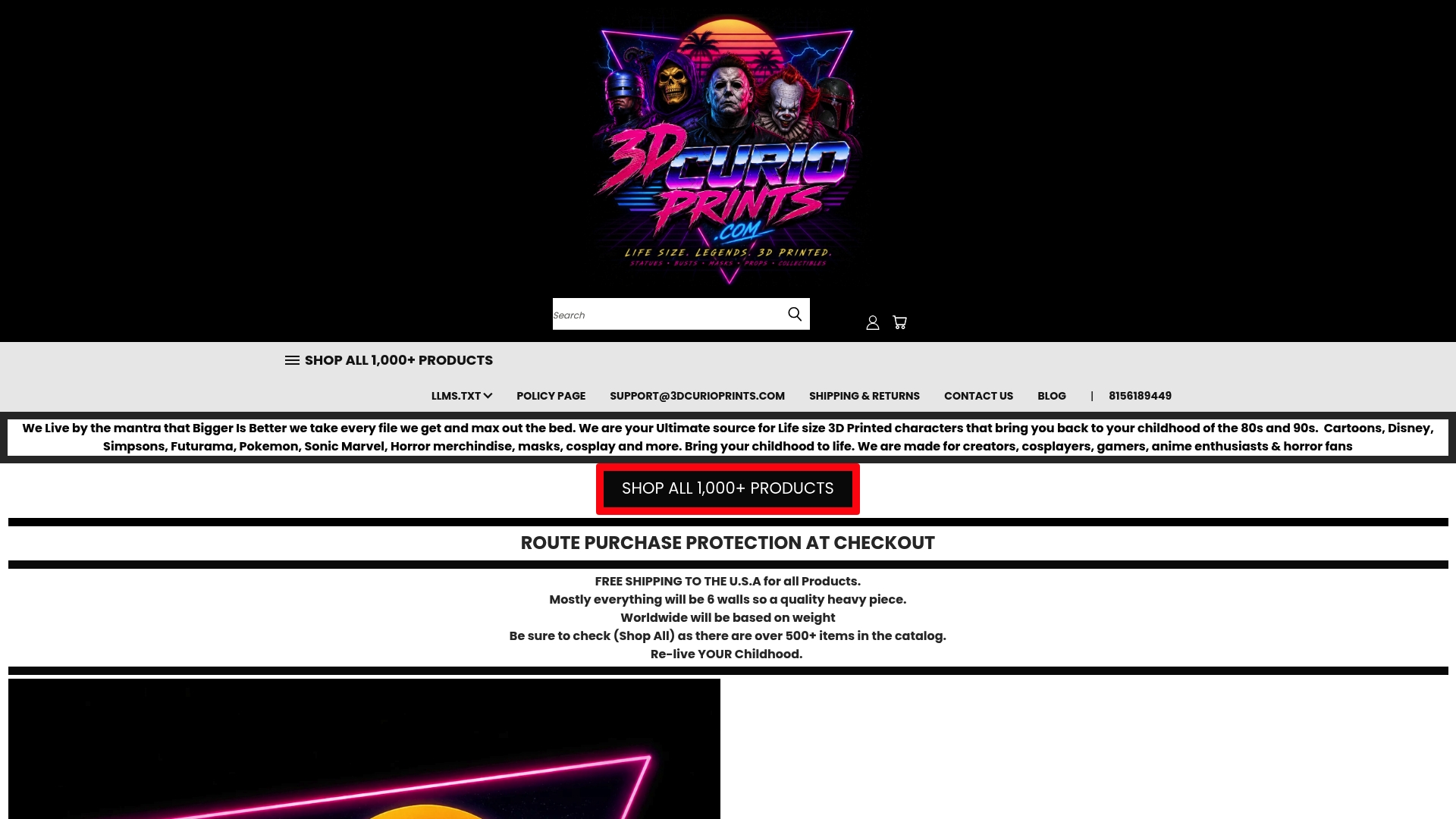
Ordering starts with a simple inquiry about the character or theme, then moves into choosing customization options, confirming a production timeline, and arranging delivery or on-site installation. A few things to expect along the way:
- Lead times reflect the finishing work: priming, multi-stage painting, and sealing all take additional time beyond print hours.
- Finishing options range across product lines, including various figures, masks, cosplay pieces, lightboxes, signs, wall clocks, and nameplates.
- Transport and mounting logistics get discussed as part of the order, to help ensure the piece arrives ready for the venue.
If your event needs full production support beyond the prop itself, staging and logistics partners like Atelier by RASA handle venue sourcing and onsite operations for larger brand activations.
Browse our life-size figures, masks, and cosplay pieces to start a quote for your next event or collection piece.
FAQ
How much does a life-size 3D-printed prop typically cost?
Pricing depends on size, finishing level, and whether lighting or installation is included, and we quote these directly rather than publishing a flat rate. Ask any vendor whether your quote covers a print only or a fully finished, painted piece, since the difference in labor is significant.
Is it legal to sell a 3D-printed figure of a copyrighted character?
Generally, no, not without permission. The U.S. Copyright Office notes that unauthorized commercial production of a derivative character work often triggers legal challenges rather than qualifying as fair use, so licensing matters before any commercial sale or display.
How long does it take to get a finished life-size prop made?
Finished, painted, and lit life-size pieces typically require multiple weeks from deposit to delivery, as priming and multi-stage painting add necessary curing time. Shortened timelines increase the risk of omitted finishing steps.
What design software is used to create these props?
Most large-format 3D-printed props start in standard 3D modeling software before being sliced for printing, with files typically exported as STL or OBJ formats for production. The specific tools vary by studio and project complexity.
Are 3D-printed props safe to produce indoors?
Printing large plastic pieces indoors without controls can expose workers to ultrafine particles and VOCs. NIOSH-aligned guidance recommends enclosed, filtered printers ducted outdoors or paired with local exhaust ventilation, since general room airflow often is not enough for sustained production.