4 Verification Checks Collectors Use to Buy Numbered Edition Statues
A numbered edition statue is a piece from a fixed production run, marked with a fraction like 25/100 that tells you the piece’s position and the total size of the edition. Before you pay for one, do this: confirm the physical number matches the certificate of authenticity, the invoice, and, where possible, the publisher’s own registration records. Skip that step and you’re trusting a piece of paper instead of the object itself.
TL;DR:
- Confirm the physical engraved or stamped number matches the certificate of authenticity and ask for clear photos before purchasing.
- Be aware that edition sizes vary widely, from a few dozen to thousands, and larger numbers do not imply lower quality or less rarity.
- Verify the edition number through multiple sources, including physical markings and production records, especially for higher-value pieces.
- Consider the purpose of your collection; a scarce edition benefits resale and investment, while a licensed figure may prioritize appearance and familiarity.
- Treat vague claims of “limited” editions without specified sizes as marketing tactics, and always require documented proof of edition size.
Table of Contents
- What Does “Numbered Edition” Actually Mean?
- How Do You Verify a Numbered Edition Statue Is Real?
- Display, Fandom, or Investment: Which Signals Matter Most?
- The Buying Checklist Every Collector Should Run
- Caring for a Numbered Statue Without Losing Its Paper Trail
- What Responsible Publishers Owe Their Buyers
- When a Custom Life-Size Piece Makes More Sense Than a Small Numbered Statue
- The Gap Between “Limited” and Actually Verified
- Sources
- FAQ
What Does “Numbered Edition” Actually Mean?
That fraction, 25/100, isn’t decoration. The first number is the piece in your hands; the second is the total edition size, and collectors lean on that denominator to judge scarcity. Outside the numbered run, you’ll often see “AP” for artist proof, a small batch set aside from the main count, plus retailer exclusives or color variants that some publishers don’t fold into the total at all. Ask what’s included before you compare edition sizes across pieces.
Edition size swings wildly by publisher. A studio piece might cap at 50; a licensed franchise release, like the kind HENI’s presskits document for its editioned work, might run into the thousands. Royal Selangor’s Colossus Victorious figurine tops out at 3,000 pieces and still sells as a genuine collectible. Bigger numbers don’t mean lesser work, and lower numbers don’t mean better craftsmanship. Some publishers assign numbers by order date, others by lottery, so piece 1/100 isn’t inherently superior to 87/100.
How Do You Verify a Numbered Edition Statue Is Real?
Verification isn’t a single document check. It’s matching several independent signals against each other, and Sotheby’s own guidance treats authenticity as a multi-source question rather than something one certificate can settle on its own.
Work through these four checks in order:
- Confirm the stated edition size. Ask the seller or publisher for the exact denominator, not a vague “limited quantity.”
- Locate the physical number on the piece. It’s usually engraved into a base plate, stamped on the underside, or printed on an interior seam. Photograph it in close up, with good lighting, before you buy or immediately after you receive it.
- Match that number to the paperwork. The engraved or stamped figure should agree exactly with the certificate of authenticity and the invoice. A COA alone is weak evidence if it isn’t backed by the physical marking.
- Get the reprint policy in writing. A reputable studio states clearly whether the mold is retired or could produce future runs.
For anything above a modest price point, contact the studio or publisher directly. Ask whether they keep a production log or registration database and whether they’ll confirm your piece’s number against it. If the seller can supply provenance, an original invoice, or exhibition history, request copies. If they can’t, that gap is information too.
Display, Fandom, or Investment: Which Signals Matter Most?
Your priorities should shift depending on why you’re buying. A fan chasing a favorite character cares most about likeness, pose, and how the piece looks on a shelf, not necessarily the fine print on edition size. An investor-minded collector reads differently: edition size, studio reputation, and a clean provenance trail matter more than a dramatic pose.
Licensing quality drives both camps more than people expect. A statue tied to a strong franchise, sculpted with real attention to detail and backed by a known studio, tends to hold interest even at a large edition size, the way Royal Selangor’s 3,000-piece Marvel release still moves as a collectible rather than mass merchandise. A weak license or rushed tooling won’t gain value no matter how tight the run is.
Price tiers roughly track this split. Small-batch studio pieces with hand-finished paintwork usually sit at the top of the market. Licensed runs with larger editions typically price lower per unit but can still appreciate if the character and studio carry weight. Neither tier is automatically the smarter buy. It depends on whether you want scarcity or you want the character on your shelf.
The Buying Checklist Every Collector Should Run
Before you click “buy,” or before you hand over cash at a convention table, run this list:
- Inspect listing photos for the actual engraved or stamped number, not just marketing shots.
- Ask the seller to photograph the number directly, since refusal to show the physical marking is a red flag worth walking away from.
- Request the invoice and COA together and check that both cite the same number.
- Confirm the studio’s stated no-reprint policy in writing, not just verbally.
- Verify the publisher or studio name against their official site or social channels.
Watch for the classic warning signs, too. CGI-only product photos, vague “limited” language with no stated denominator, and sellers who won’t discuss production records all point to risk.
Pro Tip: Build your purchase file the day you buy, not months later when you’re trying to resell. Save the invoice, listing screenshots, COA, and close-up photos of the numbered area in one folder. Future buyers, appraisers, and insurers will all ask for exactly this.
Caring for a Numbered Statue Without Losing Its Paper Trail
Condition and paperwork move together on resale. A pristine piece with no COA sells for less than a slightly worn one with full documentation, because missing paperwork creates verification problems that buyers don’t want to inherit. Keep the original box, foam inserts, and any inner packaging even after display; they’re part of the resale story.
For display itself, avoid direct sunlight, which fades paint and can warp certain resins over time. Keep heavier pieces on stable, load-rated shelving or mounts, especially anything life-size or dense enough to strain a standard shelf bracket. Store humidity-sensitive materials away from bathrooms or uninsulated garages.
Photograph the numbered area, the COA, and the invoice together, then back those images up somewhere other than your phone. A folder with the studio’s correspondence attached rounds out a file that protects both the statue’s value and your own peace of mind at claim time.
What Responsible Publishers Owe Their Buyers
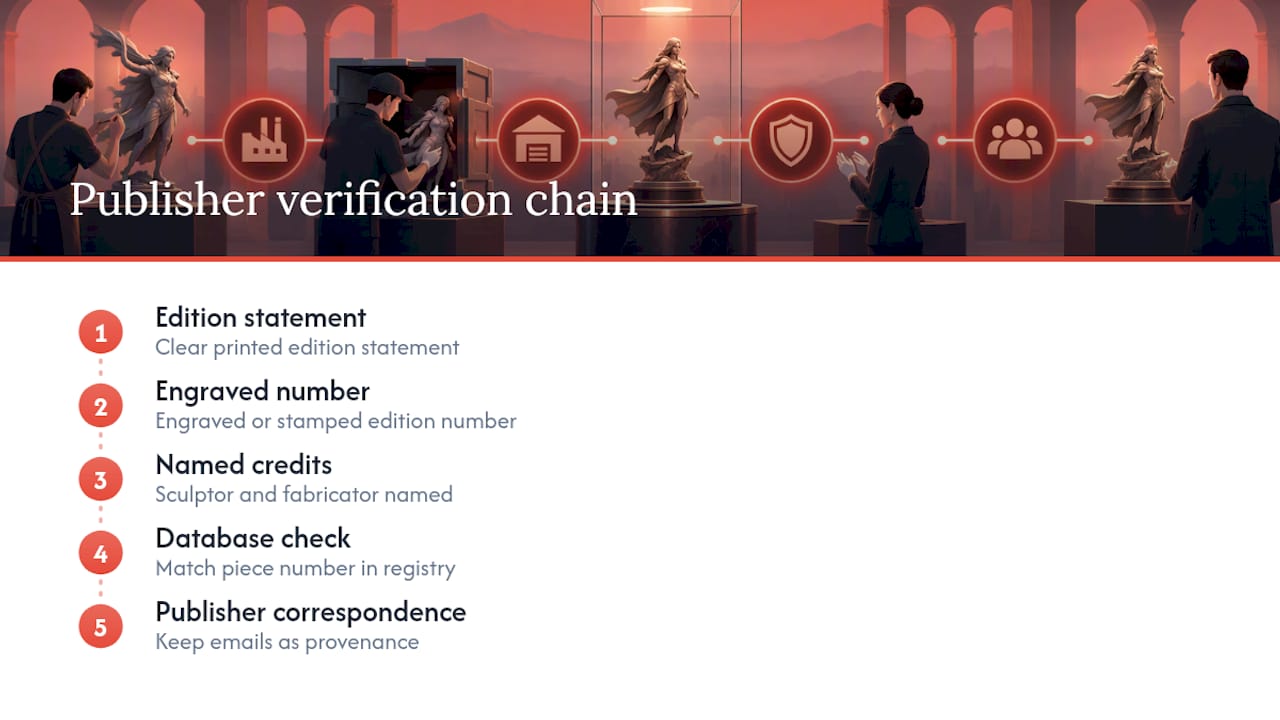
Studios that take editions seriously make verification easy instead of leaving it to guesswork. A clear edition statement, an engraved or stamped number, and named production credits for the sculptor and fabricator are the baseline, not a bonus.
Some publishers maintain a registration database collectors can check against their own piece’s number. That single step removes most of the guesswork buyers otherwise have to do themselves. A studio willing to answer a direct email about production records, reprint policy, or edition totals is telling you something about how they’ll treat you after the sale, too. Treat that correspondence as part of your provenance file. It carries weight with future buyers even without a formal document attached to it.
When a Custom Life-Size Piece Makes More Sense Than a Small Numbered Statue
Numbered editions solve for scarcity, but scarcity isn’t always the point. If what you actually want is presence, a piece that dominates a room instead of a shelf, a small numbered run of a licensed statue can feel like the wrong tool entirely.
Some studios build life-size, heavy-duty 3D-printed characters, masks, props, busts, and decor inspired by 80s and 90s pop culture such as cartoons, horror, and anime. Because each piece is often produced to order, buyers get more direct control over customization options rather than hoping a licensed run someday matches what they want. That’s a real advantage over hunting secondary markets for a specific numbered figure that may never resurface at a price you like.
If display impact matters more to you than a printed fraction on a base plate, this is worth exploring instead. Reach out through the 3D Curio Prints site to ask about specs, customization options, and production timelines, and keep your order confirmation and any correspondence as your own provenance record going forward.
The Gap Between “Limited” and Actually Verified
Most disputes over collectible statues don’t come from fraud. They come from buyers who accepted the word “limited” at face value and never asked for the denominator. A seller who says “limited edition” without stating the edition size is giving you a marketing phrase, not a fact. That gap between a real, documented edition and a vague sales claim is where most collector regret lives.
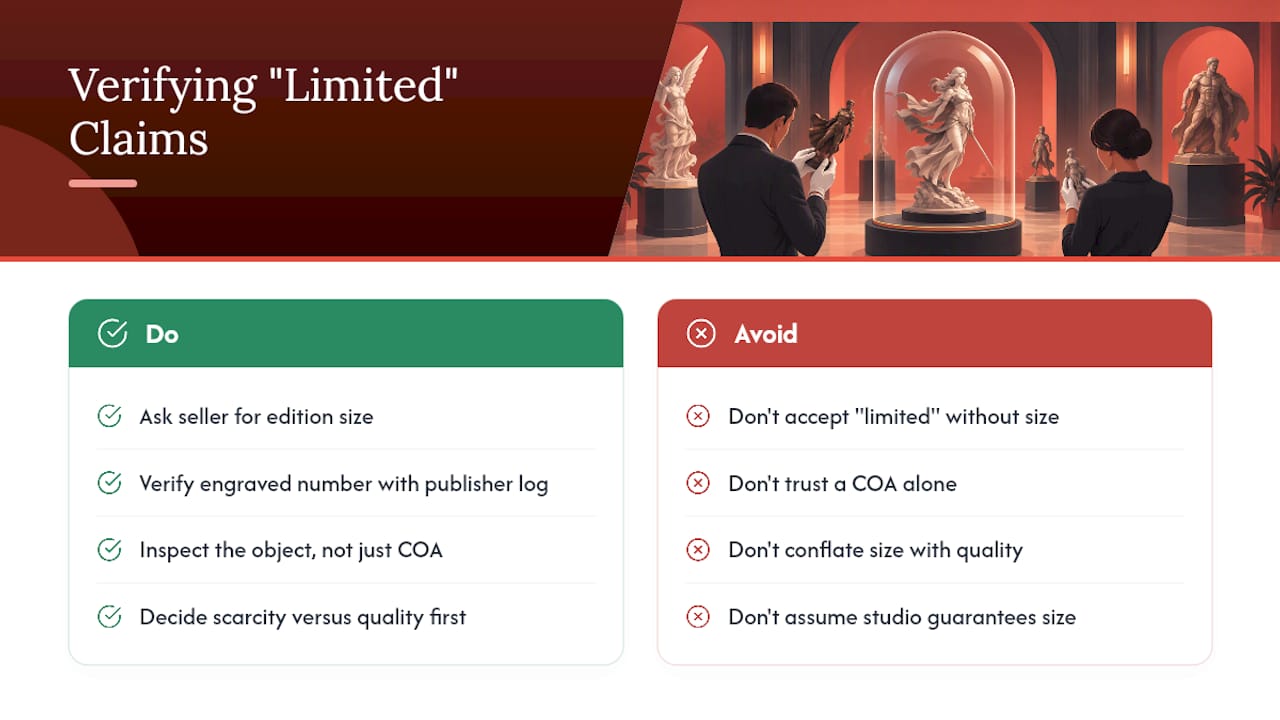
I’d argue the industry has trained buyers to over trust certificates and under trust the object itself. A COA is easy to print. An engraved number that matches a publisher’s own registration log is much harder to fake, and it’s the one signal I’d never skip checking, even on a piece from a studio I already trust. Distinguish, too, between edition size and quality; they’re unrelated variables that marketing copy loves to blur together, and treating them as separate questions will save you from both overpaying for a huge run and underestimating a small one.
For anyone weighing scarcity against presence, remember that a smaller edition number solves a different problem than a bigger, better-made piece solves. Know which problem you’re actually trying to solve before you check the fraction on the base.
— Dominick
Sources
Start with Sotheby’s primer on reading art editions, then compare publisher practices through HENI’s editions presskit and Studio Everart’s collector checklist. For general figure-buying judgment, MagicFranco’s collector guidance is a useful companion read.
- How to Read an Art Edition: Signatures, Numbers, Artist Proofs, and More | Contemporary Art | Sotheby’s
- HENI Jack White editions presskit
- Limited Edition Colossus Victorious Figurine — Royal Selangor
FAQ
What Does the Number on a Statue Actually Mean?
The first number shows the piece’s position in the production run, and the second number is the total edition size. It doesn’t rank quality; piece 3/100 isn’t better made than piece 90/100.
Is a Lower Edition Number More Valuable?
Not automatically. Some publishers assign numbers by order date or at random, so a low number can simply reflect who ordered first, not superior craftsmanship or condition.
What’s the Difference Between Open Edition and Limited Edition Statues?
An open edition has no cap on production and can be made indefinitely, while a limited or numbered edition stops at a fixed, stated total. Numbered editions carry the added step of an individual number engraved or stamped on each piece, which open editions typically lack.
Can I Buy a Custom Statue Instead of a Numbered Edition?
Yes. Custom life-size pieces, like the ones 3D Curio Prints produces from 80s and 90s pop culture franchises, prioritize display impact and personalized options over a fixed edition count, which suits collectors who want a one-of-a-kind result rather than scarcity tied to a printed number.
What Should I Do if a Seller Won’t Show the Physical Number?
Treat that as a serious warning sign. Refusal to provide matching photos of the engraved or stamped number is one of the clearest signs a listing carries more risk than it’s worth.