
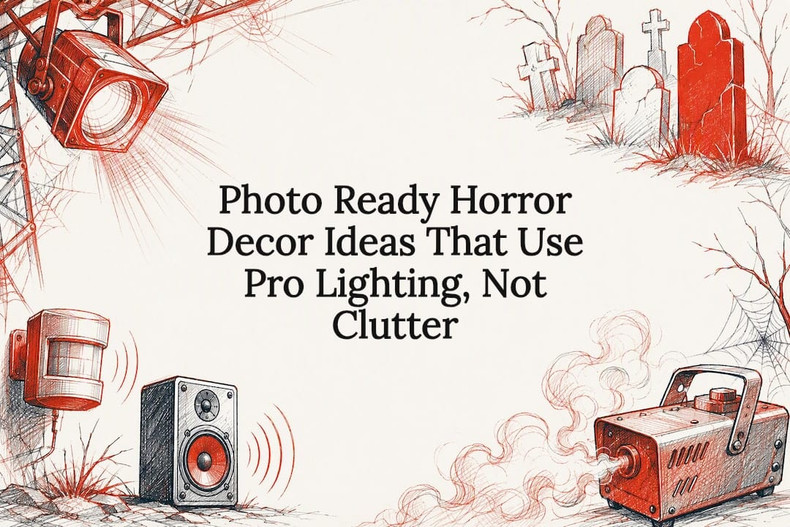
Photo Ready Horror Decor Ideas That Use Pro Lighting, Not Clutter

For the most dramatic horror decor, pick one anchor, a life-size figure, an animatronic, or a central graveyard monument, light it from below, and keep everything else intentionally sparse. An indoor vignette works best in small apartments or rentals, a yard graveyard fits homes with a lawn and foot traffic, and a full cinematic room makeover suits enthusiasts who want the theme to last past October. Choose by space and how often you want to rebuild it.
TL;DR:
- Effective horror scenes rely on a clear focal point, such as a life-size figure or animatronic, with lighting from below and minimal surrounding props.
- Outdoor setups should be carefully staggered with tombstones, fog, and colored spotlights, all built for under $100 in basic configurations.
- Layered lighting using warm base lights and colored accent spots enhances props’ visual impact, while fog placement and low-angle spots create spooky shadows.
- Reusable decorations should be weatherproofed and stored properly to last multiple seasons, prioritizing quality over cheap, disposable props.
- A strong scene can be achieved with a combination of layout, strategic lighting, and one dominant prop, rather than overwhelming with numerous small items.
Table of Contents
- Horror decor ideas by space and budget
- Three DIY projects you can finish in an afternoon
- Building a graveyard scene that reads well at night
- Lighting recipes that make cheap props look expensive
- Where 2026’s spooky-chic and Gothic Luxe trends fit in
- What to buy first at every budget level
- Adding sound and music without it feeling gimmicky
- Making horror decor reusable instead of disposable
- Choosing a life-size figure as your scene’s anchor
- A short take on what actually sells the scene
- Sources
- FAQ
Horror decor ideas by space and budget
The strongest horror scenes come from a clear category choice, not a pile of random props. Start with where you’re decorating, then match the idea to the space.
Indoor vignettes work in tight quarters and photograph well:
- A mantel display with a taxidermy skull, dripping candles, and a single spotlight reads as intentional rather than thrown together.
- An entry table with an old book, a hand emerging from a box, and low uplighting greets guests before they even ring the bell.
- A bathroom mirror smeared with fake blood text or a shower curtain silhouette turns a mundane room into a jump scare.
Outdoor setups need more planning but deliver bigger impact:
- A staggered graveyard cluster near the front walk, staged like a small stage set rather than scattered stones.
- A gothic gate or archway framing the entry path, wrapped in vines or chain.
- A lit path using low ground stakes to guide visitors toward the porch without flooding the whole yard in light.
Full room themes hold up year after year. A 90s horror room built around slasher-era props (think chain saws, hockey masks, VHS-style art) or a Gothic Luxe library corner with velvet, candelabras, and dark wood both survive as year-round decor. A single-prop anchor, a life-size figure in the corner, an animatronic that turns its head, or a blacklight-reactive window cling, changes how the whole room reads without adding clutter.
Three DIY projects you can finish in an afternoon
These three projects use cheap materials and basic tools, and each one holds up for multiple seasons if stored properly.
- Foam tombstone: cut a tombstone shape from 2-inch rigid foam insulation, carve cracks and letters with a soldering iron or utility knife, base coat in gray, dry brush with black and white for depth, then seal with exterior-grade spray sealant to weatherproof it.
- Chicken-wire floating ghost: shape chicken wire into a rough head-and-shoulders form, drape white fabric or cheesecloth over the armature, hot glue it in place, then hang the whole figure from a shepherd’s hook or tree branch with fishing line so it appears to float.
- Layered cobweb vignette: stretch polyester robbing over a corner or railing, add a layer of stretch spiderweb for texture, tuck in a plastic spider, then hit the edges with blacklight-reactive spray paint so the webs glow under UV light at night.
Pro Tip: Build your tombstones and ghost armatures in early October so the paint and sealant have time to cure before the humid nights of Halloween week set in.
Building a graveyard scene that reads well at night
Layout matters more than prop count. Stagger your tombstones by height and depth, placing taller pieces in back and shorter ones up front, which creates forced perspective that makes a small yard look like a sprawling cemetery. A basic cluster of several mixed-height stones, paired with low-lying fog and a few colored spotlights, is enough to read as a full scene rather than a handful of stakes in the grass.

A basic graveyard scene with fog and colored spotlights can be built for under $100, which makes it one of the most cost-effective ways to transform a front yard.
For fog, a standard fog machine paired with an ice chiller produces the ground-hugging vapor that reads best on camera, or you can use a purpose-built low-lying fogger. Place the fogger upwind so vapor drifts across your sightline, then aim a single low-angle spotlight across that fog line to make it glow and cast long shadows.
- Stagger stone heights and depths before adding any lighting or fog.
- Run the fogger upwind of your viewing angle so vapor drifts naturally across the scene.
- Aim spotlights low and across the fog, not straight down, to create shadow length.
- Keep cords elevated and away from the walkway trick-or-treaters will use.
Lighting recipes that make cheap props look expensive
Lighting is where most yards fall apart, and it’s also the most common mistake in home haunts. Professionals build in layers: a warm 2700K base light for general visibility, then colored accent spots (green, purple, or blue) aimed at specific props, and a separate safety light near steps or uneven ground.
- Uplight faces and props from below, since low-angle light throws shadows upward and makes any face look monstrous.
- Use blacklight sparingly on cobwebs, bones, or fabric that’s treated with UV-reactive paint for a glow that reads only in the dark.
- Choose battery or solar fixtures for spots without outlets, and low-voltage wired fixtures for anything permanent near the porch.
- Weatherproof every connection: outdoor-rated bulbs, sealed housings, and elevated cord joints keep the whole setup running through a rainy week.
Pro Tip: Test your full lighting layout after dark before Halloween night. What looks fine at dusk often washes out or overexposes once it’s fully dark.
Where 2026’s spooky-chic and Gothic Luxe trends fit in
The dominant look for 2026’s look leans toward “spooky-chic” or “Gothic Luxe”, favoring a cohesive palette over a pile of mismatched plastic. Deep burgundy, black, and metallic accents paired with tactile materials like velvet, lace, and aged metal read as higher-end than a yard full of unrelated colors.
- Pick one dominant color plus one accent, then filter every prop and light through that pairing.
- Choose a single hero piece, a figure, an animatronic, or a large monument, and build everything else around supporting it.
- Lean on texture (velvet throws, weathered wood, tarnished metal) instead of adding more plastic props.
- Revisit 90s horror motifs (slasher masks, VHS-era art, neon-and-shadow color schemes) for a nostalgic hit within the same restrained palette.
What to buy first at every budget level
Spend on lighting and fog before you spend on more tombstones. A yard with great light and modest props consistently outperforms a yard packed with props under flat white bulbs.
- Shoestring: a basic fog machine, 2 to 3 colored spotlights, and a handful of foam tombstones, built mostly from dollar-store and hardware-store materials.
- Mid-range: a low-voltage lighting kit, a chilled fogger for ground-hugging fog, and one animatronic or motion-triggered prop as a focal point.
- Premium: a life-size figure or custom prop as the anchor, layered low-voltage lighting throughout the yard, and weatherproof storage bins to protect the investment year to year.
Buy fog and lighting gear before adding a tenth tombstone. Store foam props flat, in labeled bins, away from direct sun and moisture, so they survive multiple seasons instead of crumbling by next fall.
Adding sound and music without it feeling gimmicky
A scene that looks right but sounds silent breaks the illusion the moment someone walks up. Sound works best when it’s motion-triggered and layered quietly under the visuals rather than blasting from a single speaker at full volume.
Start with a motion sensor tied to a small waterproof speaker near your main focal point, whether that’s a graveyard cluster or a life-size figure by the door. A low creak, a distant howl, or a single bell toll that triggers as someone approaches does more than a looping soundtrack that repeats every 30 seconds. Place a second, quieter speaker farther back in the scene so sound seems to come from different directions, which reads as more unsettling than one loud source.

Keep the volume low enough that neighbors and trick-or-treaters can still hear each other talk. A soundtrack that overwhelms conversation reads as annoying rather than atmospheric. If you’re running an animatronic prop, many come with built-in sound triggered by the same motion sensor that activates movement, which saves you from wiring a separate speaker system. For a room theme like a 90s horror corner, a low ambient hum or static loop under the visuals adds mood without needing jump-scare audio at all.
Test sound levels at the distance where guests will actually stand, not from right next to the speaker, since bass and dialogue both carry differently across an open yard than they do in a closed room.
Making horror decor reusable instead of disposable
Cheap decorations that crack after one season end up in the trash, and that adds up fast if you’re rebuilding the same yard every October. Building for reuse from the start saves money and cuts down on waste.
Choose materials that hold up outdoors: rigid foam, weatherproof sealant, and outdoor-rated fabric survive storage and reuse far better than thin plastic that gets brittle in the cold. A foam tombstone sealed properly can last five or more seasons if it’s stored flat and out of direct sun. Life-size figures and heavier resin or 3D-printed props hold their detail and color far longer than inflatable or thin plastic versions, which makes them a better long-term investment even at a higher upfront cost.

Storage matters as much as construction. Label bins by scene (graveyard, indoor vignette, lighting gear) so setup next year takes an afternoon instead of a full weekend of digging through boxes. Keep fabric pieces like ghost armatures and cobwebs dry and folded loosely to avoid permanent creasing.
When you do need to replace something, look for props built to last rather than the cheapest option on the shelf. Given how much consumers spend on Halloween decorations each year, buying fewer, sturdier pieces that survive year after year is often the more economical path over time, even if the initial cost is higher.
Choosing a life-size figure as your scene’s anchor
A life-size figure earns its space when you want one unmistakable focal point, whether that’s a yard graveyard’s centerpiece, an indoor hero vignette by the entry, or the photo moment guests stop for on the porch. It does the work of a dozen smaller props without cluttering the scene.
3D Curio Prints makes life-size 3D-printed figures, masks, and horror decor pieces, including custom lightboxes and signs, built heavy and detailed enough to hold up as a permanent seasonal anchor rather than a one-year throwaway. Because some pieces are custom, you can match a figure to a character or motif your room or yard theme calls for.
- Scale the figure to its space first: a life-size piece needs clear sightlines, not a crowded corner.
- Light it the same way you’d light any hero prop, low-angle and slightly colored, so it draws the eye before anything else.
- Store it upright or flat depending on the piece, away from moisture, so detail and paint hold up season after season.
Ready to build around one durable piece instead of dozens of disposable ones? Browse life-size figures, masks, and horror decor at 3D Curio Prints.
A short take on what actually sells the scene
Most horror decor fails from too many props and too little planning, not too small a budget. Light and layout do more work than quantity ever will. Build early, store flat, and let one strong focal point carry the whole scene.
— Dominick
Sources
- Halloween Landscape Lighting: Pro Effects, Safety & Portfolio 16034 Tricks 2026
- How to Build a Halloween Graveyard Scene: Layout, Fog, Lighting and Props
- Halloween decorating trends you’ll see everywhere in 2026
- NRF: Halloween survey shows consumer spending expected to reach $13.5 billion
FAQ
What is the scariest Halloween decoration?
The scariest decorations tend to be the ones lit from a low angle with colored spotlights, since uplighting throws shadows upward and makes any face look monstrous. A single well-lit life-size figure or animatronic often reads scarier than a yard full of unlit plastic props.
Why did Hobby Lobby stop selling Halloween decor?
Hobby Lobby stopped carrying Halloween-specific decorations and shifted its shelves toward fall and harvest items instead, a decision tied to the company’s values. It still sells general autumn decor, just not costumes or horror-themed props.
How do I make a house look scary?
Start with layout and lighting before adding more props: stagger tombstone or prop heights, add low-lying fog, and light the scene with layered warm and colored spotlights instead of flat white light. One strong focal point, like a life-size figure or animatronic, does more than a dozen small scattered props.
What are the Halloween trends for 2026?
The dominant 2026 look is “spooky-chic” or “Gothic Luxe”, built around cohesive color palettes like deep burgundy, black, and metallics rather than mismatched plastic props. Curated pieces with texture, such as velvet and aged metal, are replacing cluttered prop collections this year.