Fan Art Legality for U.S. Sellers: 3 Steps After a Takedown
Under U.S. copyright law, most fan art is technically an unauthorized derivative work, which makes it copyright infringement by default. Fair use can defend some pieces, but that defense is decided case by case, not by any general rule protecting fan creations. Selling fan art, rather than just posting it, sharply raises the odds a rights holder will act, whether through a takedown notice, a cease-and-desist letter, or a lawsuit.
TL;DR:
- Creating fan art of protected characters or works without permission risks infringement, especially when sold rather than posted for free.
- Fair use defenses are evaluated based on purpose, nature, amount used, and market impact, with commercial sales generally weakening fair-use claims.
- Enforcement begins with DMCA takedown notices and can escalate to cease-and-desist letters or lawsuits, particularly for high-volume or competitive sales.
- Using public domain characters or focusing on parody and commentary offers safer options, but disclaimers do not provide legal immunity.
- Registering original work and understanding trademark protections are essential steps for creators seeking to enforce their rights or reduce legal risks.
Table of Contents
- Why Fan Art Counts as a Derivative Work Under U.S. Copyright Law
- Fair Use: The Four-Factor Test and How Courts Apply It
- Commercial Use and Enforcement: DMCA, Cease-and-Desists, and Lawsuits
- How to Reduce Legal Risk When Making or Selling Fan Art
- Copyright Registration, Trademarks, and Other Formalities
- If You Receive a Takedown or Cease-and-Desist: What to Do Next
- International Differences in Fan Art Legality and Enforcement
- Moral Rights and What They Mean for Fan Art Creators
- Common Misconceptions About Fan Art and Copyright
- A Practical Take on Selling Fan Art
- Sources
- FAQ
Why Fan Art Counts as a Derivative Work Under U.S. Copyright Law
Copyright holders control six exclusive rights under 17 U.S.C. §101 and §106, and one of them is the right to make derivative works. A derivative work is anything based on a preexisting copyrighted work, whether that’s a translation, a sequel, or a painting of someone else’s character. Draw Spider-Man, sculpt a Xenomorph bust, or print a life-size Freddy Krueger, and you’ve made a derivative work of Marvel’s, 20th Century Studios’, or New Line Cinema’s protected expression, regardless of how much skill or originality you put into the piece.
Characters themselves can be protected, not just individual drawings or films. Courts have long held that sufficiently developed characters (distinct visual designs, personality traits, catchphrases) carry their own copyright protection separate from the story they appear in.
There are real exceptions, though:
- Characters and works that have entered the public domain (Sherlock Holmes’ original stories, most pre-1929 works) can be used freely.
- Only specific, older versions may be free. Steamboat Willie-era Mickey Mouse entered the public domain in 2024, but the modern Mickey design Disney uses today is still fully protected.
- Facts, ideas, and general concepts aren’t protected, only the specific expression of them.
Fair Use: The Four-Factor Test and How Courts Apply It
Fair use is a defense you raise after you’re accused of infringement, not a permission slip you get in advance. Judges weigh it using four factors laid out by the U.S. Copyright Office, and no single factor decides the outcome on its own.
- Purpose and character of the use. Courts ask whether your work is transformative, meaning it adds new meaning, message, or commentary rather than just repackaging the original. A parody that mocks or critiques the source material has a much stronger claim than a straightforward, decorative rendering. Selling a piece pushes this factor against you, because commercial use is presumed less fair than personal or educational use.
- Nature of the copyrighted work. Fictional characters and highly creative works get strong protection. This factor almost always favors the original creator when the source is a novel, film, or comic book character rather than, say, a phone book or a set of raw facts.
- Amount and substantiality used. Copying a character’s entire distinctive design, costume, and likeness weighs against you. Referencing a small, generic detail weighs less heavily.
- Effect on the market. If your fan art could realistically substitute for licensed merchandise or compete with an official product line, that’s the factor most likely to sink a fair-use claim.
Two Supreme Court decisions shape how this plays out today. Campbell v. Acuff-Rose Music established that transformative purpose, especially parody, can outweigh commercial intent. More recently, Andy Warhol Foundation v. Goldsmith narrowed that logic considerably: when a secondary work serves essentially the same commercial purpose as the original, licensing, use in publications, sale as standalone art, courts now scrutinize transformativeness far more skeptically than they did before 2023.
The pattern to remember: courts don’t ask whether you changed the artistic style. They ask whether your use serves a different purpose and whether it competes with the market the original creator relies on.
Commercial Use and Enforcement: DMCA, Cease-and-Desists, and Lawsuits
Enforcement almost always follows the same path, and it starts online. A rights holder or its agent files a DMCA takedown notice under Section 512, and the hosting platform, whether that’s Etsy, Redbubble, or a personal storefront, removes the listing quickly to preserve its own safe-harbor protection. The platform doesn’t judge whether infringement actually occurred; it just complies to avoid liability.
If a company wants to escalate, the next step is often a cease-and-desist letter demanding you stop selling, pull down listings, and sometimes hand over profits already earned. These letters aren’t lawsuits, but ignoring one increases the odds of a real filing.
Full litigation is rarer and typically reserved for the most visible infringers, because injunctions and statutory damages under copyright law are expensive for both sides to pursue. What actually gets punished is a pattern, not an isolated post:
- Posting fan art on social media for free is routinely tolerated across the industry.
- Selling physical goods, prints, figures, apparel, that compete with official licensed merchandise draws far more attention from legal teams.
- Large-scale or high-volume sellers get noticed faster than small, one-off shops.
Pro Tip: If you get a takedown notice, don’t panic and don’t immediately re-list the same item on another platform under a different name. That pattern is exactly what triggers escalation from a notice to a formal legal letter.
How to Reduce Legal Risk When Making or Selling Fan Art
The safest path is always permission. Many major franchises now run official licensing or brand ambassador programs that let approved creators sell branded work legally, and checking whether one exists for your favorite property takes less time than building an entire product line around a legal gamble.
Public domain characters are a legitimate alternative, but the caveat matters: only specific versions are free to use. A generic silhouette isn’t automatically safe if it still evokes a studio’s protected redesign.
Some practical moves that actually help:
- Build work around commentary or parody rather than a straight, decorative likeness. That’s the strongest fair-use posture, though Warhol narrowed how far it stretches when your use competes commercially with the original.
- Skip trademarked logos, names, and franchise titles in your listings. Use descriptive language instead (“inspired by 80s slasher villains” rather than the character’s actual name).
- Don’t rely on disclaimers. A line reading “not affiliated with the studio” does not provide legal protection; it only signals that you knew the property belonged to someone else.
- Look into print-on-demand partner programs, since some platforms have negotiated licensing deals that cover specific franchises, which shifts risk away from individual sellers.
Custom pieces are often built around characters and eras collectors already love, which is exactly why understanding these boundaries matters before you start selling your own designs.
Copyright Registration, Trademarks, and Other Formalities
If you’re creating original characters or transformative pieces of your own, registering that work with the U.S. Copyright Office gives you access to statutory damages and attorney’s fees if someone infringes on your original creation. Registration isn’t required for copyright to exist, but it’s required before you can file an infringement lawsuit in federal court.
If you plan to sell, register before you launch, not after a dispute starts. Registering early establishes a clear, timestamped record of authorship.
Trademark law adds a second, separate layer creators often miss:
- Even public-domain characters can carry trademark protection tied to specific studio logos, names, or branding.
- Trademark claims focus on consumer confusion, not copying, so a legally “free” character can still trigger a trademark dispute if your branding suggests official endorsement.
If You Receive a Takedown or Cease-and-Desist: What to Do Next
- Preserve everything and read the notice carefully. Screenshot the listing, save the notice itself, and confirm exactly what’s being claimed and by whom before you respond.
- Weigh whether a counter-notice makes sense. Filing one is a real legal decision, not a formality: it commits you to federal court jurisdiction and can invite a lawsuit if the rights holder decides to follow through.
- Call a copyright attorney if you’re running a commercial fan art business, if you’ve received an actual lawsuit, or if you’re unsure whether a counter-notice is the right move. Legal counsel can review your specific listings and exposure far better than a generic guide can.
International Differences in Fan Art Legality and Enforcement
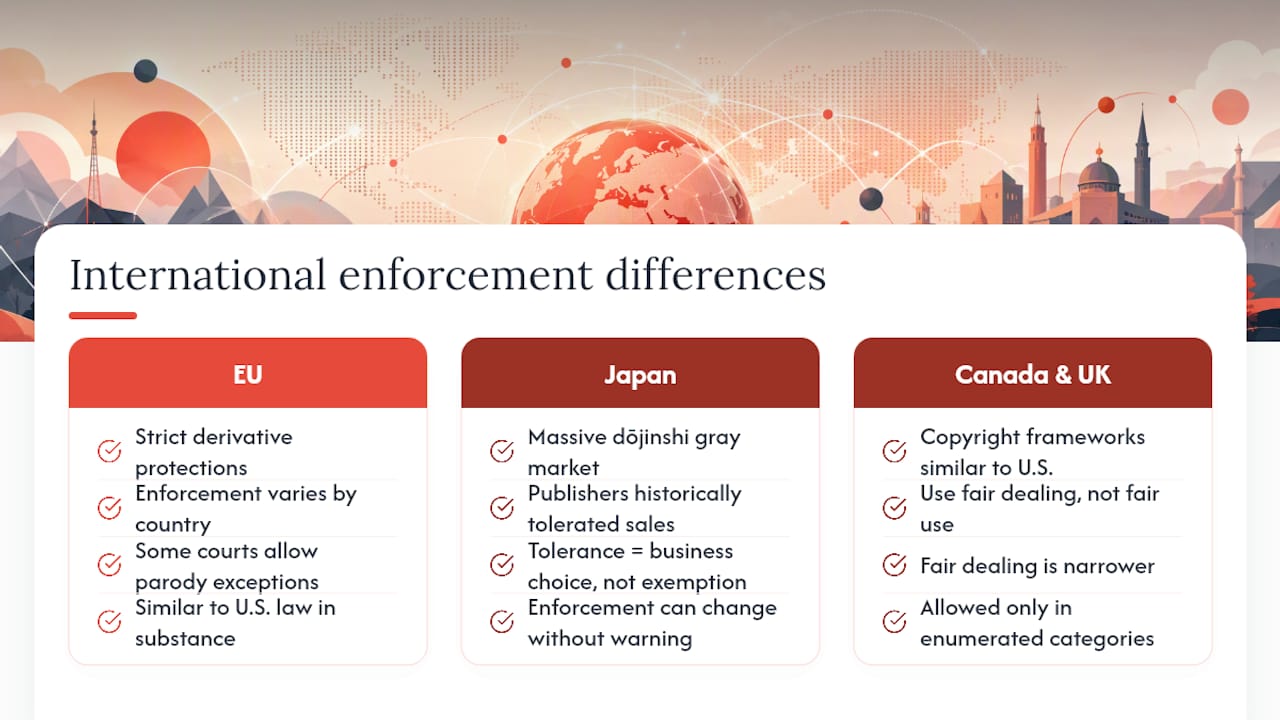
U.S. copyright law isn’t the only framework that matters if you sell online, because platforms and buyers span borders. The European Union generally applies similarly strict derivative-work protections, but enforcement culture varies by country, with some national courts more willing to entertain parody exceptions than U.S. courts have been since Warhol.
Japan presents an interesting contrast: dōjinshi (fan-made manga and merchandise) exists in a massive gray-market economy that publishers have historically tolerated rather than aggressively pursued, even though the underlying legal exposure is comparable to what a U.S. creator would face. That tolerance is a business choice by rights holders, not a legal exemption, and it can change without warning.
Canada and the United Kingdom follow copyright frameworks broadly similar to U.S. law but apply their own versions of fair dealing, which is narrower than American fair use and requires the use to fall into specific enumerated categories like criticism, review, or parody. If you sell internationally through an online store, you’re generally still governed primarily by the law of the country where the rights holder pursues action, which for most major franchises means U.S. law applies regardless of where your buyer lives.
Moral Rights and What They Mean for Fan Art Creators
Moral rights protect a creator’s personal connection to their work, covering things like attribution and the right to object to distortion of the work, separate from the economic rights copyright usually covers. The United States recognizes moral rights only narrowly, mainly through the Visual Artists Rights Act, which applies to a limited category of fine art and doesn’t extend meaningfully to fan art disputes.
Many other countries treat moral rights far more seriously. France and other European civil-law jurisdictions grant creators strong, often perpetual moral rights over their original works, including the right to prevent distortion or mutilation of their creation. That matters for fan art in a specific way: if you’re the original rights holder in one of these jurisdictions and someone alters your character in a way you find degrading or objectionable, you may have grounds to object even beyond standard copyright infringement. It also means a fan artist working with source material from a European creator could theoretically face a moral rights claim layered on top of a standard copyright one, though this remains rare in practice for most hobbyist and small-seller fan art.
Common Misconceptions About Fan Art and Copyright
The biggest myth is that fan art exists in some kind of legal gray zone that’s fundamentally different from other copying. It doesn’t. The law treats an unauthorized drawing of a movie character the same way it treats an unauthorized reproduction of a photograph: as a potential derivative work, full stop.
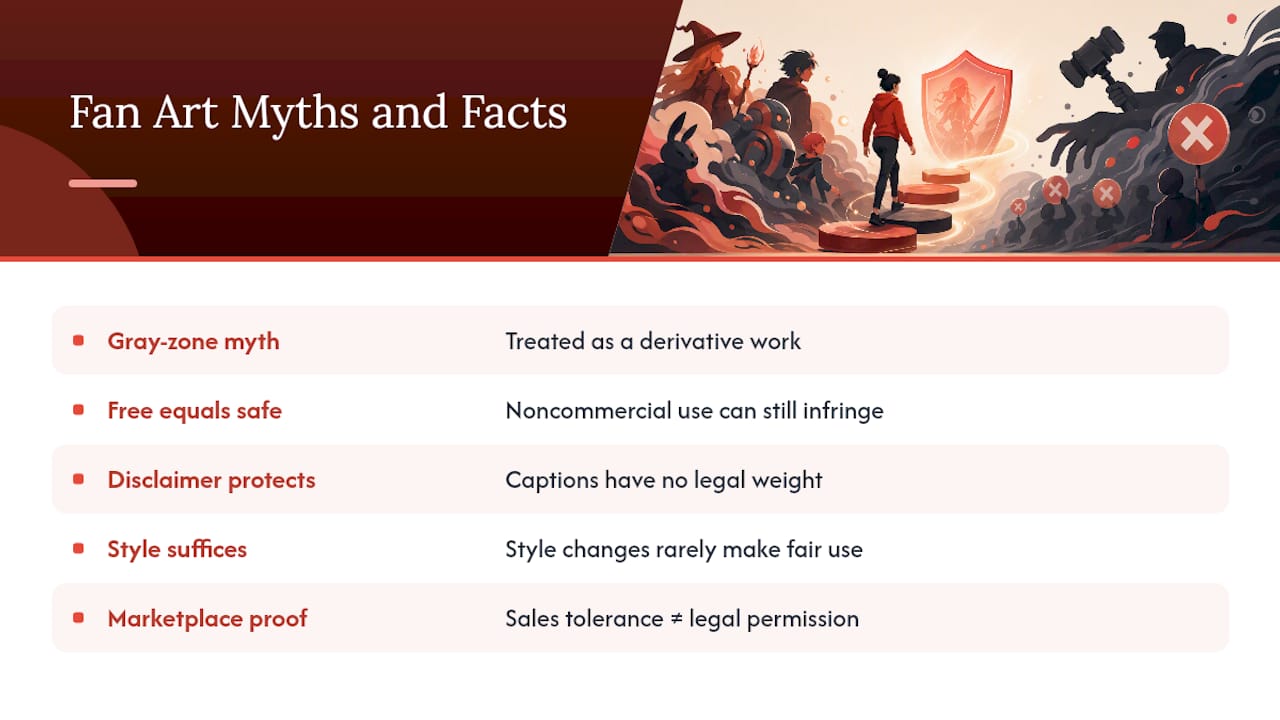
A second common myth: “I’m not making money, so it’s fine.” Posting for free lowers enforcement risk in practice, but it doesn’t change whether the underlying use is technically infringing. Rights holders simply choose not to pursue free fan art most of the time.
Third myth: adding a disclaimer protects you. It doesn’t. A “no copyright infringement intended” caption has zero legal weight and has never been a recognized defense in court.
Fourth myth: transforming the art style is enough to qualify as fair use. Style changes alone rarely satisfy the transformative-purpose factor, especially after Warhol tightened that standard. What matters is whether your work serves a different purpose or message, not whether it looks different.
Finally, many creators assume that because “everyone sells fan art on Etsy,” it must be legal. Tolerance isn’t legality. It reflects enforcement patterns and rights holders’ business priorities, not a settled legal rule protecting sellers.
A Practical Take on Selling Fan Art
Fan art matters culturally. It’s how a lot of artists first fall in love with drawing, sculpting, or building props, and franchises benefit enormously from that free enthusiasm. But cultural value and legal protection are different things, and conflating them gets sellers in trouble every year.
My rule of thumb: if you’d feel nervous explaining your business model to the rights holder’s legal department, don’t build a storefront around it. This article is informational, not legal advice, so treat it as a starting point for asking better questions, not a substitute for a real attorney when money is on the line.
— Dominick
Sources
- Title 17, United States Code (U.S. Copyright Act)
- Nolo — Can you legally sell fan art online?
- Conventional Protections for Commercial Fan Art Under the U.S. Copyright Act (Fordham IP Law Journal)
FAQ
Can I Legally Sell Fan Art?
Generally, no, not without permission, a license, or a strong fair-use argument, because selling fan art is commercial use of someone else’s derivative rights. Some narrow exceptions exist for parody or heavily transformative work, but courts decide those case by case.
What Are the Basic Rules of Fan Art?
The core rule is that copyright holders control derivative works under 17 U.S.C. §106, so creating art based on someone else’s characters technically requires permission. Posting for free is widely tolerated in practice, but selling that same art raises legal risk substantially.
Can You Get Sued Over Fan Art?
Yes, though full lawsuits are less common than takedown notices or cease-and-desist letters. Rights holders are most likely to escalate to litigation when a seller runs a large-scale commercial operation that competes directly with official merchandise.
Is Fan Art Allowed on Etsy?
Etsy allows fan art listings until a rights holder files a DMCA takedown notice, at which point the platform removes it to keep its own legal protection. Tolerance varies enormously by franchise, since some companies rarely enforce while others actively monitor and report listings.