
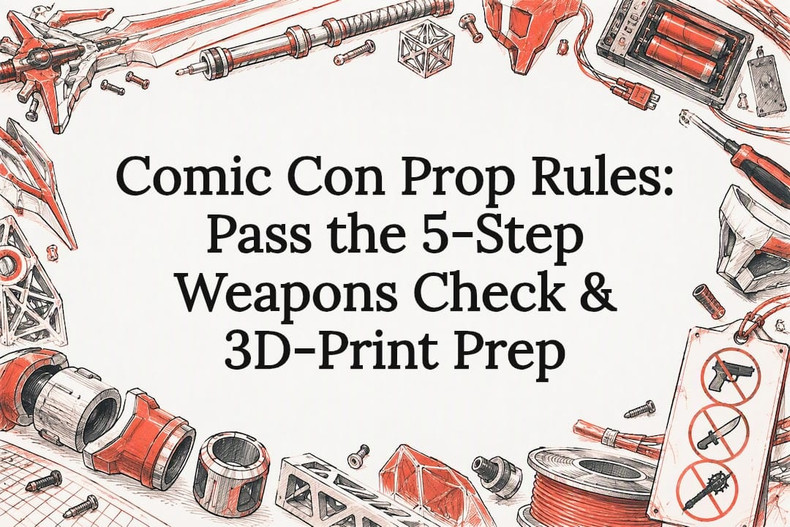
Comic Con Prop Rules: Pass the 5-Step Weapons Check & 3D-Print Prep

Most Comic Con style events ban functional and live weapons, require props to be rendered inoperable, and run daily inspection and tagging checks before you can carry anything onto the floor. To pass, your prop needs to look the part without working the part, and it needs a visible tag that proves security already looked at it. Skip either step and you risk having the item confiscated or being asked to leave.
TL;DR:
- Prop weapons must pass daily inspection, be non-functional, and display a visible tag to remain allowed on the convention floor.
- Materials such as foam, plastic, and lightweight woods are permitted, but heavy metals, glass, or brittle ceramics will fail inspection due to safety risks.
- Disassemble oversized or complex props into smaller sections before travel and use padded containers to prevent damage during transit.
- Realistic or culturally sensitive props require extra care, research, and respectful presentation, but they generally pass safety checks if constructed properly.
- Light-up props are allowed when wires are sealed, connectors rated for the load are used, and no exposed terminals or faulty wiring are present.
Table of Contents
- What props are allowed versus banned
- What happens at the weapons check table
- Building props that survive inspection
- Getting your props to and from the show safely
- Cosplay etiquette: consent, handlers, and crowd safety
- Preparing 3D printed props for inspection
- Can you get a prop pre-approved before the show?
- Realistic props and cultural sensitivity
- Electrical and battery-powered prop rules
- Why the rules exist, and how to work with them
- Build show-ready props without the inspection guesswork
- FAQ
- Sources
What props are allowed versus banned
Convention weapons policies vary by show, but the core list of banned items is remarkably consistent. Live steel, functional firearms, explosives, incendiaries, tasers, and real ammunition are off the table everywhere, no exceptions and no appeals to craftsmanship.
Most shows do allow replica and costume weapons, provided they meet a few conditions. Foam, plastic, wood, and 3D printed PLA pieces generally pass, as long as they have no sharp edges, no glass components, and no heavy metal in the primary structure.
- Firearm-like props typically need a bright orange barrel cap, an inoperable firing mechanism, and a zip-tied trigger, with security often adding their own visible marking.
- Melee weapons like swords and axes need rounded edges or blunted tips, and many shows require peace-bonding so the weapon stays attached to a sheath or the costume itself and can’t be drawn on the floor.
- Realistic replicas of real-world weapons draw extra scrutiny even when they’re clearly props, because security weighs how a prop looks to a stranger in a crowded hallway, not just how it’s built.
- Oversized or heavy pieces face added restrictions regardless of material, since a prop’s weight and rigidity matter as much as its sharpness.
The Indiana Comic Convention weapons policy spells out a version of this standard that many regional shows mirror: no functional weapons, no live steel, and prop firearms must show a safety cap and a secured trigger before they’re allowed past the door. If you’re building something that resembles a licensed firearm, assume you’ll need all three: the cap, the tie, and a staff member’s sign-off.
What happens at the weapons check table
Every major show routes prop weapons through a dedicated checkpoint before you reach the floor, usually called a Costume Props Desk or Weapons Check. Comic Con’s own guidance confirms that props need daily inspection at these stations, and that approved items get a visible tag you must keep attached for the rest of the day.
Here’s what typically happens once you’re at the table:
- A staff member checks whether the prop is functional in any way, including hidden mechanisms.
- They inspect for sharp points, exposed blades, or edges that could cut someone in a crowd.
- They review the materials, looking for glass, heavy metal, or anything that could shatter.
- They confirm attachments are secure, especially on swords or staffs that need peace-bonding.
- If everything checks out, they apply a tag or sticker that must stay visible for the remainder of that day, since many shows require you to re-tag each morning.
If a prop fails, expect an escorted removal from the floor. Unapproved items generally cannot sit in coat check, so you’ll need to take it back to your car, hotel room, or storage area. Repeated attempts to sneak a rejected prop back in can lead to confiscation or ejection. Prop Safety Officers and convention security have final discretion, and their call on a borderline item is the one that sticks, regardless of what a different show allowed last month.
Building props that survive inspection
The materials you choose to decide how your prop performs at the checkpoint, long before a staff member ever picks it up. Foam, plastics, cardboard, lightweight woods, and standard PLA filament for 3D printed pieces all pass muster at most shows. Heavy metals, glass, and brittle ceramics tend to fail, not because they look dangerous, but because they genuinely are: they can cut, shatter, or injure someone in a packed hallway.
- Round every edge and point. A blunted tip with a soft rubber cap reads as deliberate safety design, not an afterthought.
- Add fillets at stress points. Reinforcing joints where two pieces meet keeps a print from shattering if it’s bumped or dropped.
- Skip the heavy core. A solid metal rod inside a foam sword adds weight security will flag, even if the outside looks harmless.
- Design for teardown. Oversized props often need to dismantle into smaller sections without tools, and some shows set specific size limits for items like staffs.
Weight matters as much as sharpness. A prop that’s awkward to carry or swings unpredictably in a crowd creates a hazard even if it’s made from foam. Balance your build so one person can control it without bracing against a wall or a stranger.
Pro Tip: Build your largest props in sections from the start, with hidden dowel joints or magnetic connectors, so breakdown for inspection or transport takes seconds instead of a toolbox.
Getting your props to and from the show safely
Travel days create their own risks, separate from what happens at the convention door. TSA guidance on costume items warns that sharp, explosive-looking, or otherwise hazardous replicas may need to go in checked baggage and could be barred from carry-on entirely. Treat anything that resembles a real weapon the way you’d treat the real thing until you know the airline’s specific call.
- Keep realistic props covered or boxed in transit, not visible on a sidewalk, in a rideshare, or in an airport terminal.
- Pack fragile 3D printed pieces with padding between sections to prevent cracks from shifting cargo.
- Disassemble anything oversized before you leave for the venue, both for your own transport and for the prop desk’s inspection.
- If a hired vehicle or group shuttle is part of your plan, build extra loading time for large or multi-piece props, a detail covered well in planning transport for fan conventions.
If a prop is denied at the door, your options are limited to returning it to your car or hotel or shipping it home. Some shows will hold purchased items from vendor booths in sealed packaging or mail them to you after the event rather than let you carry them through the hall.
Cosplay etiquette: consent, handlers, and crowd safety
“Cosplay is Not Consent” is the standard most conventions and cosplayer communities operate by, and Naka-Kon’s etiquette guidance puts it plainly: a costume, no matter how revealing or recognizable, never implies permission to touch or photograph someone without asking first.
- Ask before you photograph, and ask again before you touch a costume or prop, every time.
- Pose in a stationary, open spot rather than brandishing a prop while walking through foot traffic.
- Bring a handler or spotter for anything large or heavy, both to manage crowd space and to field requests on your behalf.
- Report harassment or unsafe handling of your prop to convention security immediately rather than handling it yourself.
Respecting the space around you matters as much as the prop itself. A dramatic pose in a narrow hallway can turn a great photo into a safety incident in seconds.
Preparing 3D printed props for inspection
3D printed pieces pass inspection faster when they’re built with the checkpoint in mind from the first layer. Document how you rendered any mechanism inoperable, whether that’s a sealed battery compartment or a permanently glued trigger, so you can show a staff member exactly what they’re looking at instead of explaining it from memory.
- Choose PLA over brittle resins for anything load-bearing or likely to get bumped in a crowd.
- Reinforce stress points with internal infill increases or printed ribs rather than relying on surface thickness alone.
- Sand every visible edge and add a rubberized tip to blades, points, or barrel ends.
- Bond fragile joins with epoxy rather than friction-fit pins that can snap under a security check’s handling.
Pro Tip: Print a small card or tag describing your prop’s materials and safety features, and keep it with the piece. Handing it to a Weapons Check staffer speeds up the review and shows you built with the rules in mind.
For transport, quick-detach joins and a padded crate make the difference between a prop that survives the trip and one that needs field repairs before you reach the floor.
Can you get a prop pre-approved before the show?
Some conventions offer a way to check a prop’s status before event day, usually through an email submission to the organizer’s security or guest services team, a photo upload through a registration portal, or a line item in your badge confirmation that points you to the weapons policy page. Coverage varies widely by show, and plenty of mid-size and regional conventions don’t offer any pre-approval path at all, leaving the first real check for the day you arrive.

If a pre-approval option exists, it’s worth using for anything borderline, like a large firearm replica or a weapon with moving parts. Submitting photos ahead of time, along with a description of the materials and any safety modifications, gives organizers a chance to flag problems while you still have time to fix them. Bring a printed or saved copy of that approval to the show itself, since the person at the Weapons Check table on the day may not have access to your email submission.
When no formal process exists, your best substitute is reading the published weapons policy closely and erring on the side of over-disclosure at the checkpoint. Volunteering details about your prop’s construction, rather than waiting to be asked, tends to speed up the review and reduces the odds of an on-the-spot denial.
Realistic props and cultural sensitivity
A prop doesn’t need to be a weapon to draw scrutiny. Items modeled on real cultural, religious, or historical objects can carry weight beyond their physical construction, and a thoughtful cosplayer treats that context as part of the build, not an afterthought.
If your costume references a specific culture’s dress, weaponry, or symbolism, research the object’s actual significance before you replicate it. A prop that’s sacred or ceremonial in its original context can read very differently to someone from that background than it does to you, even when your intent is pure appreciation. This doesn’t mean avoiding the character or costume entirely; it means building with awareness and being ready to speak to your choices if someone asks.
Security checks focus on physical safety, not cultural judgment, so a culturally sensitive prop will usually pass inspection the same way any other prop does if it meets the material and construction rules. The etiquette concern sits with you and the people around you on the floor, not with the Weapons Check table. When in doubt, a quick conversation with people familiar with the source culture, or a respectful note in your own presentation of the costume, goes further than guessing.
Electrical and battery-powered prop rules
Light-up props, from glowing staffs to illuminated masks, are common at Comic Con style events and generally allowed, but they come with their own set of expectations. Exposed wiring, loose battery compartments, or anything that gets noticeably hot during use is the kind of detail that draws a second look at inspection.
Seal battery compartments securely so cells can’t fall out or short against metal contacts while you’re moving through a crowd. Use connectors rated for the current your LEDs or small motors draw, and avoid splicing wires with exposed copper left uncovered by heat shrink or electrical tape. If your prop uses a rechargeable battery pack, test it under load before the show to confirm it doesn’t overheat after an hour of continuous use, since convention floors run warm and crowded.

There’s no universal voltage or wattage cap published across shows the way there is for prop length, so the practical rule is to build to general consumer electronics safety standards: enclosed wiring, properly rated connectors, and no exposed terminals. A Weapons Check staffer who sees a tidy, sealed electrical compartment is far less likely to flag it than one who sees loose wires or a battery taped on with no cover.
Why the rules exist, and how to work with them
Weapons policies exist because one bad incident can end a convention’s relationship with its venue permanently. That’s not an abstract risk. It’s why a Prop Safety Officer’s judgment on your foam axe matters more than how screen-accurate it looks.
The good news is that safety and craft aren’t opposites. Rounded edges, hidden breakdown joints, and sealed electronics can sit right alongside sharp detail work and paint accuracy. The best props on any convention floor usually pass inspection on the first try.
— Dominick
Build show-ready props without the inspection guesswork
We create 3D printed characters, masks, and props with inspection day in mind: reinforced joins instead of brittle single-piece prints, PLA construction that holds detail without the weight or shatter risk of heavier materials, and designed-to-dismantle features for anything oversized.
If you’d rather skip the trial-and-error of building a safety-compliant prop from scratch, browse our life-size characters, masks, and cosplay props or reach out for a custom build suited to your next convention.
FAQ
What are the key unwritten rules of cosplay?
Ask before touching or photographing someone’s costume, keep weapon props pointed down and secured while walking, and follow whatever weapons check or tagging process your show requires. Most of these habits exist to keep crowded hallways safe and to respect other attendees’ space.
What isn’t allowed at Comic-Con?
Live steel, functional firearms, explosives, incendiaries, tasers, and real ammunition are banned outright. Beyond that, items with sharp edges, heavy metal construction, or working mechanisms typically fail inspection even if they’re intended as costume pieces.
Can I bring a prop sword to Comic-Con?
Yes, as long as it has a blunted or rounded edge, passes a daily inspection at a Costume Props Desk, and is peace-bonded to your costume or a sheath so it can’t be drawn once you’re on the floor. Expect to re-tag it each day you bring it back.
What is the golden rule of cosplay?
“Cosplay is Not Consent,” meaning a costume never implies permission to touch, photograph, or approach someone without asking first. It’s the standard most conventions and cosplay communities enforce alongside their weapons and safety policies.